
|
|
|
Photo
of the Month |
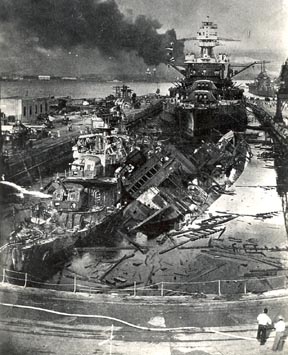
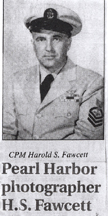 Cousin Harold S. Fawcett (1917-1999), a
Navy photographer stationed at Pearl Harbor in late 1941, reached immortality in
about 1/500 of a second, the approximate length of time it took him to snap this
historic image. The photo shows the wreckage of the U.S.S. Pennsylvania
and destroyers Downes and Cassin, in the aftermath of the Japanese
attack on Pearl Harbor on Dec. 7, 1941. The New York
Times reported that he "captured memorable scenes of the
Japanese attack ... Some of [his] photographs of
mighty American warships exploding, burning and rolling belly up were considered
too disturbing to be made public soon after the outbreak of World War II. These
images began to be published on the first anniversary of the attack in Life
magazine and in many American newspapers." Later in the war, based on the Bikini atoll, he "photographed the
detonation of two hydrogen bombs." This photograph has been reproduced in many books, including
Collier's
Photographic History of World War II.
Cousin Harold S. Fawcett (1917-1999), a
Navy photographer stationed at Pearl Harbor in late 1941, reached immortality in
about 1/500 of a second, the approximate length of time it took him to snap this
historic image. The photo shows the wreckage of the U.S.S. Pennsylvania
and destroyers Downes and Cassin, in the aftermath of the Japanese
attack on Pearl Harbor on Dec. 7, 1941. The New York
Times reported that he "captured memorable scenes of the
Japanese attack ... Some of [his] photographs of
mighty American warships exploding, burning and rolling belly up were considered
too disturbing to be made public soon after the outbreak of World War II. These
images began to be published on the first anniversary of the attack in Life
magazine and in many American newspapers." Later in the war, based on the Bikini atoll, he "photographed the
detonation of two hydrogen bombs." This photograph has been reproduced in many books, including
Collier's
Photographic History of World War II.
After the war, Harold returned to his hometown of Grafton, Taylor County, WV, where he spent the remainder of his life. He was the grandson of Robert Patterson Fawcett of Webster, near Grafton, and the great-great grandson of Phoebe (Miner) Fawcett, an early pioneer of Preston County, WV. At his death in 1999, Harold received a prominent obituary in the New York Times.
[Update - This photograph continues to be widely used and was published in the Pittsburgh Post-Gazette on Dec. 7, 2008, on the 67th anniversary on the attack, in a story headlined: "USS Pennsylvania, Damaged At Pearl Harbor, May Be Gone But Her Guns Survive."]
Copyright © 2006, 2008 Mark A. Miner