
|
William Hall |
William Hall was born in November 1846 in Fayette County, PA, the son of Joseph and Elizabeth Hall and stepson of Elizabeth (Rowan) Hall.
He was a casualty of the Civil War. His father once said that "I have no record of my marage to the Soldier's Mother or her Death nor the soldiers Birth but to the best of my recolection [he] was born about 1846."
When he was age 13, in 1850, details of that year's federal census enumeration show him dwelling with his parents in Wharton Township, Fayette County. He never married.
|
Tattered battle flag, 116th PA Infantry Library of Congress |
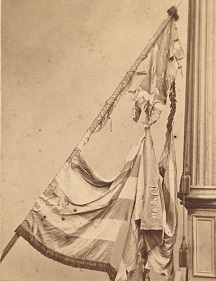
Among the other soldiers in the regiment was Silas Younkin, of Company E, a distant step-cousin by marriage.
In his 1903 book The Story of the 116th Regiment Pennsylvania Volunteers, in which William is named, author St. Clair A. Mulholland writes:
Company K was recruited in Fayette County, and on a beautiful spring evening the company marched to the railroad depot in Uniontown to take the cars for the seat of the war. The little city had sent hundreds of others during the previous three years, and hardly a family but had passed through seasons of sorrow, and the crape had floated from many a door-bell for the soldiers who would never return. Nearly every able-bodied man was at the front already and now all the schools were being deserted to swell the army. All the town turned out to see the last company leave for the field. The train was waiting and the local band that escorted the company ceased to play when the depot was reached. The ranks were broken to allow the leave-taking, every one of the boys had been loaded with all the tokens of affection and things of use- fulness that love could suggest, and all that remained was to exchange the last embrace, the last loving, heartfelt kiss, and say farewell. Then the cars moved off amid sobs and tears, the band played a farewell salute, cheers mingled with the mother's subdued weeping, and the train was soon out of sight. The crowd slowly dispersed, each one going to the lonely home to think of the boy who, living or dead, would be for all time to come the idol and hero of the family. Company K left Uniontown with eighty-one in the ranks. Within one short year twenty were killed in battle or had died of wounds. Eight had died of disease and four had died in southern prisons. Thirty-two out of eighty-one were sleeping in soldiers' graves.
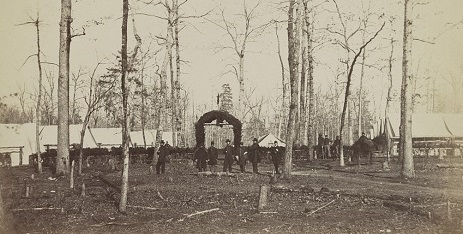 |
| Above: field hospital of the 1st Division, 2nd Army Corps near Brandy Station, where William first was treated for the measles. Below: Harewood General Hospital beds covered with mosquito nets, and medical staff - Library of Congress |
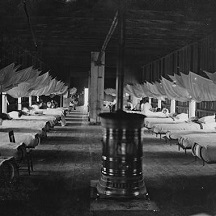 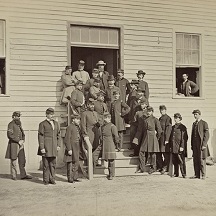 |
William was on the regiment's rolls for March and April 1864, likely at Brandy Station, VA, the winter quarters of the Army of the Potomac. But that spring, he became ill with the measles and was sent to the 1st Division, 2nd Army Corps Hospital near Brandy Station. Then on April 20, 1864, not having improved, he was admitted to Harewood General Hospital in Washington, DC. His ailment was diagnosed as "rubeola," a highly contagious form of the measles, often spread when an infected person sneezed or coughed. Then on May 17, 1864, at Harewood, he received a 60-day furlough and returned home.
He never recovered. The soldier's stepmother, Elizabeth (Rowan) Hall, tried to help nurse him back to health, likely using home grown remedies such as roots and herbs. Many years later, his father Joseph recalled that "My son Wm. Hall came home about Oct. 64 sufering with the measels. He was very Poorly and Doctored with a Doctor of Uniontown I do not recolect his name. but from Good information the Doctor is (Dead). My son continued to get weeker from sale measels every Day and in about seven weeks died." Family friend Martha Rankin of Hopwood recalled that she visited the soldier:
...at the home of Thomas Grover shortly after he came home from the army... He had taken cold and was quite black in the face... He died in about one week after I saw him and died of the measels. I was present at his funeral. It was moderate weather when I saw him but cannot fix the date.
The soldier's former neighbors, Margaret Rankin and Sarah M. Rankin, gave testimony in writing that they had known him before the war, as near neighbors, that they remembered him as the main source of support for his parents, with Margaret personally acquainted with his death and attended his burial. Signing this affidavit as a witness was Martha "Mattie" (Knight) Jennings, a relative on the Harbaugh side of the family who lived in Ohiopyle.
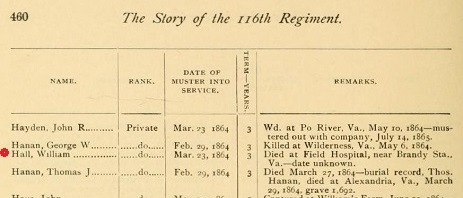 |
| William's name in the history of his regiment - Internet Archive |
The official military record shows that death swept William away at home on June 27, 1864, while the family's memory set the date as Oct. 10, 1864. No cause or place of death information was received at the Surgeon General's Office. However, the military's record of the death was issued many years later, from the War Department, on Nov. 1, 1887, signed by Adjutant General R.C. Drum.
A notation of his service and death was printed in Mulholland's book, but with an error stating that death occurred at Brandy Station.
More than two decades later, on Nov. 8, 1886, his father Joseph applied for a hardship military pension as compensation for the loss of his son. [Father App. No. 346.670] After Joseph's death, his widow (the soldier's stepmother) applied for a nurse's pension as compensation for apparently treating him at his last illness.
The claim was denied.
Copyright
© 2000, 2004, 2006, 2008, 2014, 2017, 2019-2020, 2025 Mark A. Miner |
Minerd.com extends appreciation to David Magiske for providing his Hall genealogy for this biography. |