| Photo of the Month October 2026 |
|||||
| See Previous Photos Unknown Faces and Places |
 |
|||
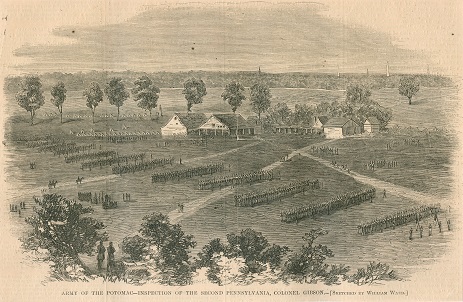
| Sketch by William Waud | |||
This rare Civil War era sketch shows the formal inspection of the 2nd Pennsylvania Heavy Artillery under the watchful eye of Col. Augustus A. Gibson. It was drawn by William Waud, known to have produced highly realistic wartime scenes for Harper's Weekly during the Petersburg Campaign, Sherman's March to the Sea and President Lincoln's funeral.
Four soldiers in the extended Minerd-Minard-Miner-Minor are known to have served in the 2nd Artillery, among them Samuel Hall (Battery K), Franklin C. Miner (Battery H), Robert Rankin (Battery K) and Joseph Benton White (Battery K).
The 2nd Artillery was stationed in early 1862 at Camden, NJ. It spent most of its first two years building and staffing a ring of fortifications around the District of Columbia, fearing that the nation's capitol would be vulnerable to Confederate invasion. These forts included the earthen Fort Stevens to the north. This fort is notable because with Lincoln there and watching, it came under fire in July 1864, in an attack by Confederate Gen. Jubal Early. It was the only time in American history when a seated chief executive came under fire from an enemy combatant during wartime.
The regiment saw its first battle on July 15, 1864 in one of the first assaults of the siege of Petersburg. It also took part in the Battle of Chaffin's Farm in September 1864 in Virginia and an attack on nearby Fort Harrison west of New Market Heights.
Hall contracted the measles in Camden. He later deserted but returned to his regiment and was court-martialed. He served his sentence served a sentence "at Ft. Ethan Allen, Va. to forfeit all pay & allowances due him, $10 per month of his monthly pay for 6 months..." He secured his release from confinement in about June 1864 and returned to military duty. Having again become sick, he was away for treatment in the general hospital in July and August 1864 but was present on duty in September 1864 through the end of the war.
Miner in August 1862 was "detached" from the regiment as an artillery instructor for the 113th New York Volunteers. Then in October 1862, after returning to his regiment, while on duty in Fort Thayer in the District of Columbia, he became sick with rheumatism. When the 2nd Artillery was called to the front in May 1864, he remained behind at Fort Thayer "on account of being laid up with rheumatism," and treated by Surgeon Griswold, recalled friend Edward de C. Loud. Again in June 1864, at Fort Ethan Allen, he was detached as an artillery instructor.
Rankin, during a charge on the enemy's line near Petersburg, VA, was shot in the right leg below the knee. He was sent to the Corps Hospital at Point of Rocks, VA and then to Hampton Hospital, VA, where the ball was removed. In August 1864, he was transferred to David's Island, NY for treatment, and then was moved to Haddington Hospital, Philadelphia, where he reported after returning home on furlough. Later, Rankin was sent to Satterlee General U.S. Hospital in West Philadelphia and stayed there for the remainder of the war. Several other injured veterans, among them Michael Ansell Firestone and Ephraim Miner, also were treated at Satterlee at one time or another.
White's wartime details are not known. After the war ended, he mustered out Jan. 29, 1866 at City Point, VA. Later that year, however, he re-enlisted in the regular Army, Co. E, 16th U.S. Infantry, on Dec. 6, 1866 for a three-year term. He was on duty at Augusta, Macon and Atlanta, GA, from 1867 to 1868.
Among the Younkin-Younken-Youngkin-Youngken relatives, two also are known to have staffed the 2nd Artillery -- William Stroh (Battery M) and Simon Youngken (Battery B).
 |
|
Copyright © 2026 Mark A. Miner |