
|
James
Eyster Murdock Sr. |
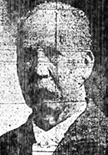 |
James E. Murdock |
James Eyster Murdock Sr. was born on New Year's Day, 1842 in Kingwood, Preston County, WV, the son of John Smart and Rebecca (Miner) Murdock.
He stood 5 feet 5 inches high, with light hair and grey eyes. As a soldier in the Civil War, he rose from private to brevet captain, saw action in 28 battles and was wounded four times.
When James was granted an increase in his federal pension for his war service, the West Virginia Argus said: "These old veterans deserve all they will ever get from the government, and more too."
On Nov. 1, 1870, at the age of 28, he was united in holy matrimony with 25-year-old school teacher Martha Ann Basnett (1845-1913). Martha is the earliest known woman educator in our family, teaching grade school for girls in Preston County circa 1869. She received a grand total of 34 cents for her work that year.
The family of children they produced were William Henry "Willie" Murdock, Julia Caywood Jennings, Minna Basnett Davis, and James Eyster Murdock Jr.
James
enlisted as a private in the 7th West Virginia Infantry on July 4, 1861 at Kingwood. His regiment also apparently was known as the "Preston Guards." He was later promoted up through the ranks to brevet captain. He was wounded at the battles of Antietam, Fredericksburg,
Spotsylvania and Cold Harbor.
James' full battle list included Romney, Bloomery, Front Royal, Port Republic, Malvern Hill, Harrison's Landing, South Mountain, Antietam, Fredericksburg, Chancellorsville, Gettysburg, Williamsport, Robinson's River, Auburn, Bristoe Station, Bull Run, Mine Run, Morton's Ford, Wilderness, Spotsylvania, Petersburg, North Anna River, Totopotoing, Deep Bottom, Hatcher's Run, Ream's Station, Bardstown and Cold Harbor.
 |
|
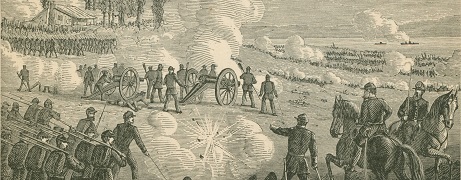
Battle of Malvern Hill, during the Seven Days Campaign near Richmond, ending the Union's attempt to end the war by capturing the Confederacy's capital city. |
For the wound received at Fredericksburg, he was treated in Mt. Pleasant Hospital, Washington, DC, for two months. At the Battle of Cold Harbor, he was struck on the top of his head by a sharpshooter's bullet. At Gettysburg, he was in the thickest of the battle defending Little Round Top.
At the Wilderness, he suffered from painful swelling of his neck glands. He apparently was wounded in the foot in battle at Williamsburg in May 5, 1862, as he is listed by name in a Confederate newspaper, The Petersburg Daily Express, Extra edition, dated May 10, 1862, which apparently reprinted a similar list from the Lynchburg Republican of May 1862. (The extraordinarily rare Petersburg broadsheet was offered for sale at auction in 2008 by Bloomsbury Auctions.) ~ A Heroic Stand at Antietam's Bloody Lae ~ Then at Antietam, on Sept. 17, 1862, James and the 7th West Virginia joined the 14th Indiana, 8th Ohio and 132nd Pennsylvania infantries as part of French's Division of the the 2nd Army Corps who fought gallantly at the Bloody Lane, also known as the Sunken Road. In a fascinating twist, James was fighting side-by-side with three other cousins in two other regiments from two other states -- William Henry Miner and Franklin Charles Wintermute with the 132nd Pennsylvania and William "Henry" Alderman of the 8th Ohio.

Facing enemy troops commanded by Gen. Robert E. Lee, the 7th West Virginia engaged in desperate fighting, which eventually led to Union possession of the sunken lane, where some 5,000 men fell that day killed and wounded. Writing in Landscape Turned Red, author Stephen W. Sears says that their commanding officer Brig. Gen. William H. "Old Blinky" French "relentlessly drove the last of his Federal brigades into savage battle... Under his command were the only veteran regiments in the division, the 8th Ohio, 14th Indiana and 7th West Virginia."
The details of the day's action for the 7th West Virginia are described in D. Scott Hartwig's book, I Dread the Thought of This Place. Hartwig writes that in the area of the Bloody Lane/Sunken Road, several New York and Pennsylvania regiments were not moving and did not seem to be engaged. “The Pennsylvanians and [West] Virginians swept by them and over the remnants of the two New York regiments who were still fighting on the ridge. Reaching the crest, they received the same deadly reception the others had," he writes. "Officers shouted for the men to lie down and return the fire, and the Pennsylvanians and [West] Virginians mirrored what the New Yorkers before them had done – that is, ‘lie down just under the top of the hill and crawl forward and fire over,’ then crawl back and repeat the process.”

Johns Hopkins University Press
The 7th West Virginia found itself directly opposite the oncoming 30th North Carolina Infantry. Says Hartwig, “The Federals’ 7th [West] Virginia, in Wright’s left front, recoiled slightly at the appearance of this new Confederate force.” Several Confederate officers thought that meant they were falling back and thus ordered a charge on the West Virginians. “The colonel shouted for fixed bayonets, and the brigade surged up out of the lane.” The Union responded “by ordering the 7th [West] Virginia and the 132nd Pennsylvania to refuse – that is, to bend their line back – and extend their line to protect the flank.” One member of the 132nd Pennsylvania wrote that “We fired such a voley into them that they soon went back and with less men.”
Dr. Isaac Scott, surgeon of the 7th, and Dr. Thomas McEbright of the 8th Ohio, organized an aid station “directly in the rear of French’s division. On September 17, Scott estimated that they dressed the wounds of some 1,500 men while bullets, shells, and cannonballs were ‘whistling around our heads like hail all day’.”
Years later, an observer wrote that "In this road there lay so many dead rebels that they formed a line which one might have walked upon as far as I could see. They lay just as they had been killed apparently, amid the blood which was soaking the earth."
Hartwig concludes that "The Federals paid a terrible price in breaking the Confederates’ Sunken Lane line." Of the 5, 731 men of French's Division who went into battle, 30 percent fell. "The smallest loss for any regiment in this division, the 7th [West] Virginia, was 145, which offers some idea just how dreadful the carnage was,” he says.
 |
|
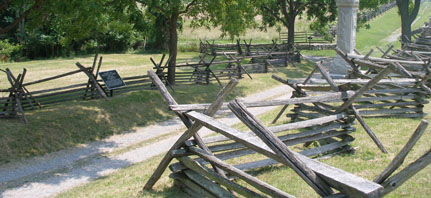
Before and after -- the Sunken Road/Bloody Lane at Antietam, where James and the 7th West Virginia saw horrific bloodshed. Library of Congress |
|
|
 |
Preston County Journal, 1874 |
After being discharged Nov. 24, 1864 at Petersburg, VA, James returned to Kingwood. He became a teacher and a blacksmith, but due to poor health, he gave up that work. For many years he was a clerk in dry goods, drug and hardware stores.
In the decade before the turn of the 20th century, James helped organize the Soldiers Reunion of Preston County. One of these was held at Kingwood in late August 1891. As a charter member of local Knights of Pythias, he led summer ceremonies of an "imposing procession [of members which] wended its way to the beautiful Kingwood cemetery and remembered the brothers gone before."
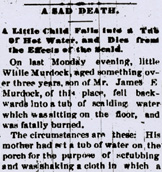
Heartache struck the family in the fall of 1874 when three-year-old son Willie Murdock died at home after falling into a tub of hot water. In a lengthy obituary, the Preston County Journal reported that he "was an unusually bright, intelligent, and winning child, full of innocent prattle, he was everybody's pet; and being the only child, his loss is a very, very sad one to the sorrowing father and mother."
His mother had set a tub of water on the porch for the purpose of scrubbing and was shaking a cloth in which a few bits of bread had been placed, when a mouse jumped out of the cloth, and ran near Willie and frightened him; and while running backward from it, out of the room, his foot struck the door sill and threw him into the tub. His mother was standing near and grabbed him before he touched the water, but his his apron string broke and let him down, of course, he was taken out very quickly by the frightened mother, and his clothes torn from him, and it was thought the burn was not very deep nor of a very serious nature. Medical aid was immediately summoned, but all efforts proved unavailing, and Willie gradually grew worse until about 4 o'clock Tuesday evening when, after experiencing two or three paroxysms, he passed gently away.
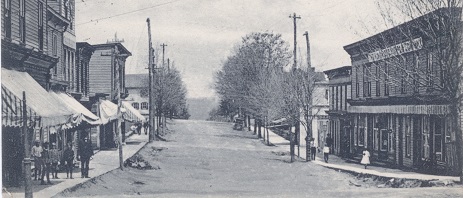 |
Price Street in Kingwood |
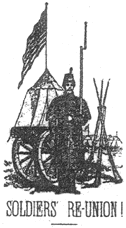 |
Preston County Journal, 1891 |
The funeral was "peculiarly impressive and solemn, and the neighbors mingled their tears with those of the grief struck parents, said the Journal, "who mourn not as those without hope; for they know, that, although his little footsteps and cheering prattle will be heard no more, and his place at the hearth stone and table will be vacant, one more seraph has been added to that 'innumerable company which no man can number,' and 'sings around the throne of God in Heaven..." The procession to the Maplewood Cemetery was followed by "a large number of sympathizing friends."
James and Martha somehow found the strength to overcome the tragedy. They went on to have three more children following Willie's death.
Circa 1878, when daughter Minnie was born, the birth took place in Culpeper, VA.
When the federal census was enumerated in 1880, the couple is shown in Kingwood, with James earning a living as a blacksmith. That year, Martha's 55-year-old aunt Julia A. Basnett lived under their roof as did a 21-year-old fellow blacksmith and a student boarder.
The 1910 census of Kingwood lists James as a hardware salesman.
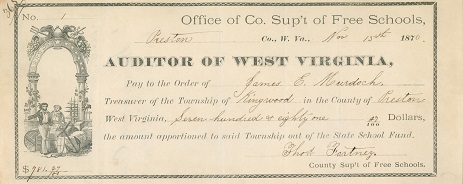
Active in his community, James held the office of Adjutant of the local post of the Grand Army of the Republic (GAR), a veterans organization, for several years. He also was township treasurer; postmaster under the first administration of President Grover Cleveland, and secretary of the Board of Education of Kingwood for 15 years. His detailed reports on annual school performance were published in the Preston County Journal, and a copy of the 1870 report is in the Minerd-Miner-Minor Archives.
James also was secretary of the Kingwood Methodist Episcopal Church Sunday School for 25 years, missing only two Sundays in that time. In January 1873, he was elected president when the young men of the church organized a Young Men's Prayer Meetings Association, "to hold meetings at 4 p.m. each Sabbath," according to the 1950 booklet entitled Through the Years: A History of Methodism in Kingwood, West Virginia, and authored by Ethel Peaslee Beerbower. His brother Charles Edgar Murdock also was a member of this prayer association. During 1878-1879, when a new church building was erected, James and his parents and brother Marcellus Hugh Murdock contributed funds for the work. The dedication service was held on May 25, 1879.
Among James' other community commitments were as a member of the Independent Order of Red Men and the Order of United American Mechanics.
In late June 1912, the West Virginia Argus reported that Martha was in Newfield, NJ, "visiting her daughter" Minna Davis.
|
|
|
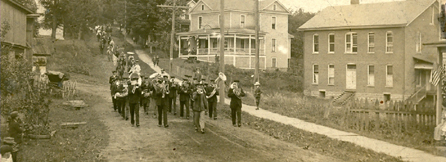
Above: Fourth of July parade in Kingwood in 1910. Check James received as township treasurer from the county superintendent of free schools, 1870. |
 |
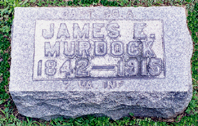 |
Maplewood Cemetery, Kingwood |
Martha died on Aug. 5, 1913. The place and cause of her death are not yet known, although her demise could have been in Kingwood.
James outlived her by 20 months. He passed away on April 19, 1915 at Kingwood. The Preston County Journal reported that "Only a short time before [his death], possibly less than an hour, he had been on the street conversing with friends. He had gone home and had lain down on the sofa to rest and about ten minutes before he was found dead he had conversed with members of his family. Shortly before six o'clock his son, James E., Jr., came in and went into the room where he was and spoke to him, and upon getting no response he went to the sofa and discovered that his father was dead." His death was top headline news in the April 22, 1915 edition of the Journal.
Both are buried at Maplewood Cemetery, Kingwood.
~ Daughter Julia Caywood (Murdock) Jennings ~
Daughter Julia Caywood Murdock (1875- ? ) was born in October 1875 in Kingwood. She was named for an aunt by marriage, Julia (Caywood) Murdock, wife of Thomas I. Murdock of Ironton, OH.
When she was 24 years of age in 1900, unmarried, she lived at home with her parents and had no occupation. The 1910 federal census shows her continuing to reside with her parents and earning a living as a seamstress and dressmaker.
|
Rev. John H. Debolt |

The federal census of 1930 shows the couple residing in Washington, Washington County, PA, with the 74-year-old Robert working as a shrubbery salesman, and the 55-year-old Julia having no occupation. Their address was 247 West Wheeling Street, and they belonged to the West Washington Methodist Episcopal Church. Reported a newspaper, "He was widely known as a song leader [in the church] and had assisted in that capacity frequently and with great acceptability, in evangelistic services." A number of Julia's distant cousins on the Miner family tree also belonged to the West Washington congregation.
Sadly, already suffering from hardening of the arteries, Robert was stricken with a pulmonary edema at the age of 72 and died on Dec. 7, 1931 in Washington. Following funeral services in the family church, led by Rev. John H. Debolt and Rev. E.H. Greenlee, his remains were taken to Pittsburgh to be placed into eternal repose in Allegheny Cemetery.
~ Daughter Minna Mae Basnett (Murdock) Davis ~
Daughter Minna Mae Basnett Murdock (1878-1946) was born on Dec. 5, 1878 in Culpaper, VA but grew up in Kingwood.
Minna was a school teacher in Kingwood in 1900, when she was 21 years of age.
At the age of 29, on Oct. 10, 1908, Minna married 30-year-old Willis "Clifford" Davis (1880-1940) in Preston County. He was the son of Joseph and Sarah (Graham) Davis. Rev. George B. Dever, minister of the Baptist Church in Kingwood, performed the nuptials.
They produced one daughter, Sarah M. Johnson.
Early in the marriage, the Davises lived in the Panama Canal Zone, with Willis employed in a personnel capacity for construction of the canal. Then in 1910, the Davises moved to New Jersey, making their residence in Newfield, Gloucester County, and where he obtained a position as cashier of the First National Bank. In June 1912, Minna's mother traveled to visit them.
The federal census enumeration of 1920 shows the Davis family living in Landis Township, Cumberland County, NJ, on Weymouth Road. Clifford's employment was written as "clerical - ship yard."
Minna was a substitute teacher in local schools in Newfield. Their home was located at 107 Church Street, and he continued his line of work until death. They were members of the Newfield Methodist Church.
Willis began to suffer from prostate cancer and underwent surgery in September 1930. He endured the illness for another decade, and the cancer spread to his lungs. He was admitted to the U.S. Naval Hospital in 1940 but never recovered. At the age of 61, in Philadelphia, he died on Sept. 6, 1940. His remains were returned to Newfield for interment in Rose Hill Cemetery, and a short death notice appeared in the Vineland Daily Journal.
In widowhood, Minna lived for another six years. She was admitted to Newcomb Hospital where she succumbed at the age of 67 on Sept. 7, 1946. Rev. Maurice Outland, pastor of her church, officiated. Pallbearers included Edward Scheidt, Raymond Lowder, Harry Davis, Louis Austino, Charles Skinner and Garrie Bostwick. An obituary appeared in the Daily Journal. [Find-a-Grave]
Daughter Sarah M. Davis (1914-1995) was born on New Year's Day 1914 in Vineland, Cumberland County, NJ. She married Carl Johnson ( ? - ? ). Circa 1946, their home was in Newfield, NJ. Her final years were spent in San Diego, CA. There, she died at the age of 81 on May 17, 1995. Her remains were shipped back to New Jersey to rest near her parents at Rose Hill.
~ Son James Eyster Murdock Jr. ~
Son James Eyster Murdock Jr. (1884-1961) was born on March 4, 1884 in Kingwood.
Unmarried at the age of 26, in 1910, he worked as a typesetter in the printing office of the Preston County Journal.
In 1912, James wedded Ethel Estelle Jenkins (Nov. 1, 1889-1968), a native of Fisher, IL and the daughter of James J. and Victoria (Clark) Jenkins. News of their marriage license was published in the Fairmont West Virginian. On March 21, 1912, the Journal reported that the 27-year-old James and 22-year-old Ethel had eloped:
[He] slipped away from Kingwood to Morgantown where he was joined by Miss Ethel Jenkins, going on to Fairmont where they were married by the Rev. Harry C. Howard, who was a former pastor of the Kingwood M.E. Church. The bride is a daughter of J.J. Jenkins of Terra Alta and is very well known to our people. She was a trusted employee in The Journal composing rooms for four years and resigned her position in December. The groom is one of Kingwood's well-known young men and he too was employed in The Journal office until about a year ago when he resigned the position... Both are pleasant young people and have hosts of friends throughout Preston county who will wish them much happiness.
Ethel resided in Fairmont at the time of marriage. The couple did not reproduce.
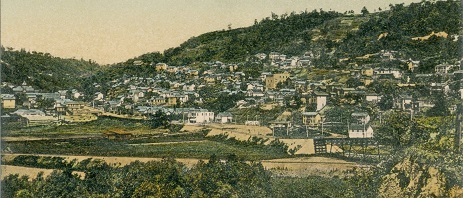 |
East Liverpool, Ohio, where the Murdocks lived from 1929 into the 1960s |
By 1920, the couple had relocated to Akron, Summit County, OH, where they lived with Ethel's parents. That year, he continued his occupational specialty as a printer in a publishing company, and Ethel's father worked as a millwright in a rubber business.
Then in 1929, they moved again to East Liverpool, Columbiana County, OH, where he secured work as a printer in the newspaper office of the East Liverpool Evening Review. The position must have been secure, even through the depths of the Great Depression, and James remained with the newspaper until retirement in 1960. Their address over the years was 801½ St. Clair Street.
Circa 1941, James was president of the East Liverpool Typographical Union 318. During that period, Ethel served as special activities chairman of the Stewart Friendly Class of the First Methodist Episcopal Church and was a member of the Auxiliary of Typographical Union. They often hosted visits from Ethel's parents until the death of her father in September 1942.
James retired from the Evening Review after more than three decades of service on May 21, 1960. A dinner for 65 guests -- among them newspaper officials and members and officers of the Typographical Union -- was held in the Travelers Hotel. As a parting gift, he received a wallet from outgoing union president Joseph Gebauer. In a story about the event, the Evening Review reported that "Murdock and his wife are thinking of a Southern vacation later this year."
Sadly, James only lived for a little more than a year in retirement. He succumbed on July 28, 1961.
Ethel lived as a widow for seven years. became deathly ill at home on July 25, 1968 and was rushed to the City Hospital in East Liverpool, where she was pronounced dead on arrival at the age of 78. Burial was in Columbiana County Memorial Park.
|
Copyright © 2000, 2004-2005, 2008, 2017-2018, 2020 Mark A. Miner |
|
Stereoview of Antietam sunken road courtesy of the Library of Congress |