|
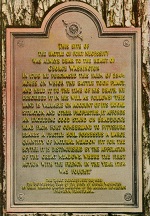
Braddock's Grave |
|
The Family's Role in Preserving George Washington's Historic French &
Indian War Sites in Fayette County, Pennsylvania |
 |
| George Washington and "The Night Council at Fort Necessity," 1754 Courtesy G.P. Putnam & Co., 1856. McNevin del.; H.B. Hall; printed by W. Pate |
|
Maj. Gen. Braddock |
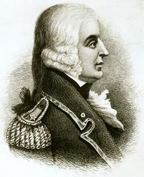
The French & Indian War was triggered in the summer of 1754 near Uniontown, Fayette County, PA. This region of Pittsburgh and Southwestern Pennsylvania later became the epicenter of our Minerd- Minard- Miner- Minor family.
While our pioneer Minerd ancestors had not yet arrived in the area by that time, several of our cousins have played key roles in more recent years with the preservation of important sites that today are part of the Fort Necessity National Battlefield.
One of the key landmarks of the spark that ignited the war is Fort Necessity, where a young English officer George Washington led an ambush of the unsuspecting French at Jumonville, followed by losing the first military battle of his life in a hastily built wooden fortification. Upon retreating, Washington's troops made an overnight stop at a second landmark, the Camp of Twelve Springs.
George
Washington -- age 40
The third site of note is "Braddock's Grave" monument marking the resting place of the ill-fated British Army officer, Maj. Gen. Edward Braddock. Having returned to the region with Washington a year later, in 1755, he was mortally wounded in battle at what is now Braddock, near Pittsburgh, while leading an expedition toward Fort Duquesne. Washington presided over the secretive burial.
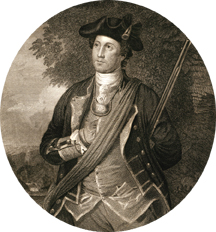
Engraved by J.W. Paradise, from a picture
by J.G. Chapman, painted by C.W. Peale
~ Family Connections at These Sites ~
Cousin William Alexander Gaither (husband of Hannah Maria Minerd) was hired by the property owners to serve as caretaker of the Braddock's grave site in the 1870s, a role which he continued for many years.
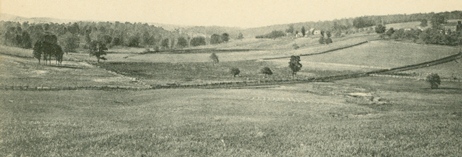
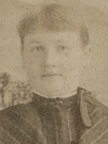
Cousin Clara (Leonard) Holt -- of the family of Reuben H. Leonard -- owned a farm 12 miles east of Fort Necessity -- a portion of which was known as the "Camp of the Twelve Springs." Washington and his beaten army camped there after surrendering Fort Necessity on July 4, 1754, and the following year, Braddock made his eighth encampment there on June 25, 1755. An article in the Uniontown Daily News Standard reported in 1932 that "Outlines of the old springs and the tavern are still visible." Clara had what a newspaper called "considerable interest in the historical significance of the farm on which she lives." Her sons made an effort to locate each of the dozen springs on the property. In 1932, she paid to have a commemorative marker produced and placed. John Kennedy Lacock, an authority on the Braddock expedition, and professor of history at Harvard University, organized a dedication service on Sept. 11, 1932. Yet the site never fully captured the public's attention. By 1937 John P. Cowan, park ranger and historian at Fort Necessity, wrote to the editors of the Uniontown Daily News Standard saying "everybody has overlooked" the area.
|
Clara (Leonard) Holt |
At Fort Necessity, two known cousins were on the maintenance and grounds crews for a number of years. One was Delbert L. "Bert" Ravenscroft Sr. (of the family of Sarah [Rankin] Addis) was employed on the maintenance staff for 33 years. During the time that he worked there, under superintendent Melvin J. Thorpe, the park expanded "from a two-acre site in 1939 with one employe to 350 acres and five permanent employes today," said a March 1969 article in the Uniontown Morning Herald. Another, Joseph E. Liston Sr., of the family of Elizabeth (Rowan) Hall, was responsible for not only the fort site and Braddock's Grave but also the Mount Washington Tavern. As well, cousin Clarence Thomas Helterbran, a laborer with the Works Progress Administration, was employed on the work crew that helped to reconstruct the fort.
David X. Hall and his sons Winfield Allen, John Kenneth and Earl -- sons of David X. and Alice Margaret (Cassidy) Hall of the family of Henry and Mary (Hull) Hall -- joined forces with a number of local men in July 1935 in cleaning and weeding historic sites including Jumonville's Grave and Washington's Rocks. The others were Joe Fitzsimmons, Dan Varndell, Daniel Varndell, Ludwig Wedel, John Varndell, Wesley Johnson, Russell Varndell. Under the supervision of road construction foreman John Bradley, the men tore out undergrowth allowing the sites to be "more attractive and easier to locate," reported the Morning Herald. "For the past year nothing has been done at either site and weeds and underbrush had taken firm root to grow up over tablets and other markers, making them difficult to find.... Refreshments were furnished gratis throughout the day by Harry Whyel, proprietor of Jumonville Inn. The workers visited the spots again yesterday for a last minute's survey befor letting the general public in on the back-breaking labor contribution which has resulted in two of the county's historic spots again becoming places that apparently have been given special care to perpetuate Fayette's historic sites and make them drawing cards for the large number of tourists who frequent this section and Fort Necessity."
This page contains rare vintage images from the Minerd.com Archives. Rights to reproduce these images for follow-on publication or broadcast can be obtained by contacting the webmaster.
~ Washington's First Foray into Southwestern Pennsylvania ~ |
|
|
|
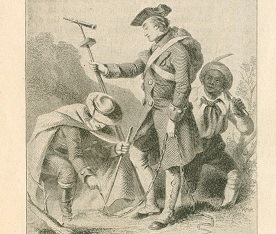
Washington leading a survey crew using rod and chain technology. From a print by “Darley” and “G.R. Hall.” Life of Washington by Washington Irving, Farm and Fireside Library, May 1896. |
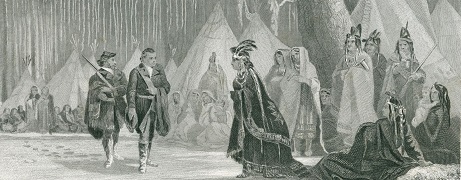 |
| Washington and companion Christopher Gist visit with Queen Allequippa during their diplomatic mission to French-held Fort LeBoeuf, December, 1753. Life of Washington: A Biography, Personal, Military, and Political, by Benson John Lossing. (New York, Virtue & Co., 1860. Steel engraving by John Rogers from original by John McNevin.) |
|
|
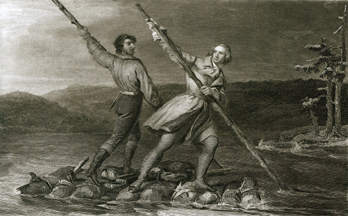
| Washington and companion Christopher Gist cross the icy Allegheny River near present-day Pittsburgh, nearly drowning a few days after Christmas 1753, on returning from a failed diplomatic mission to the French army at Fort LeBoeuf (today's Waterford, PA). History of the United States, by Harry Bartlett (1854). |
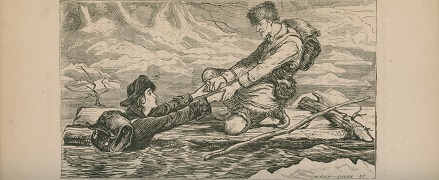 |
| Gist rescuing Washington from the frigid Allegheny River in December 1753. Our Western Border, 100 Years Ago, by Charles McKnight (Philadelphia: J.C. McCurdy & Co., 1876). |
 |
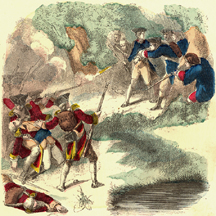
| An Indian shooting at Washington and Gist, whom they captured and released. The Eclectic Primary History of the United States, by Edward S. Ellis (New York-Cincinnati-Chicago: American Book Company, 1884) |
~ Washington's Fight Against the French at Fort Necessity ~ |
|
|
| British assassination of French forces in 1754, under the command of 22-year-old Maj. Gen. George Washington, killing French Ensign Coulon de Villiers, sieur de Jumonville, known as the original "shot heard 'round the world" which ignited the French and Indian War. The Illustrated Life of Washington, by the Hon. J.T. Headley (1860). |
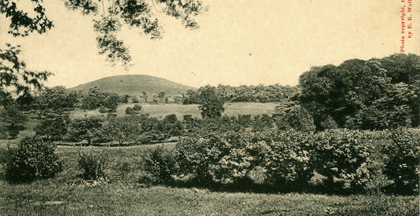 |
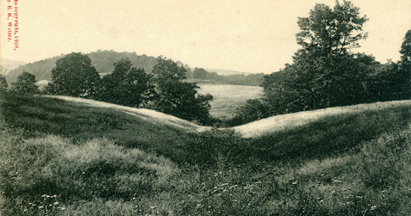
| Dunbar's Knob at Jumonville, PA, near where Washington ambushed Jumonville's forces in 1754. No. 41, Braddock Road Series by John Kennedy Lacock, Amity, PA. E.K. Weller, Washington, PA. |
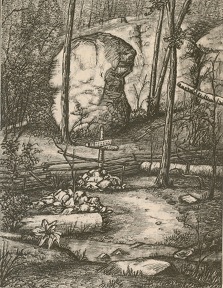 |
Jumonville's grave. History of Fayette County, Pennsylvania, by Franklin Ellis, 1882. |
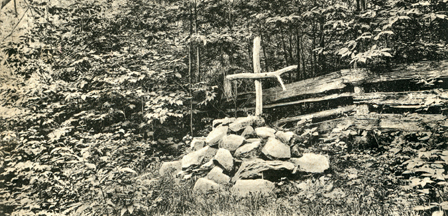 |
Grave of Jumonville. #A 51859, The Rotograph
Co., New York City. Postmarked 1906. |
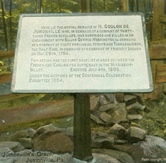 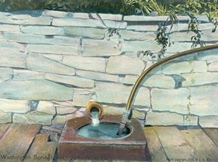 |
Plaque marks Jumonville's grave. Right: Washington's Spring water
collection basin, early 20th century, on the site of an encampment by Washington's troops. |
~ Braddock's Defeat and Burial ~ |
|
|
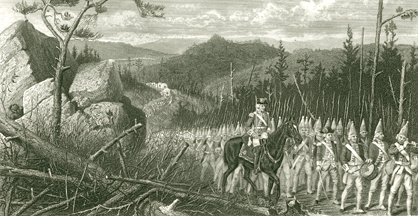
| "Braddock's March," drawn by A.B. Frost and engraved by H.B. Hall, Jr. United States History, by William Cullen Bryant (1881). |
|
|
| Washington counseling Braddock about his alarm in seeing regulars march into the wilderness as though on parade, with drums beating, fifes playing and colors flying, to take on an enemy who often used ambush tactics in battle. Braddock responded that he knew his own business and did not thank the young officer for the advice. The Eclectic Primary History of the United States, by Edward S. Ellis (New York-Cincinnati-Chicago: American Book Company, 1884) |
|
|
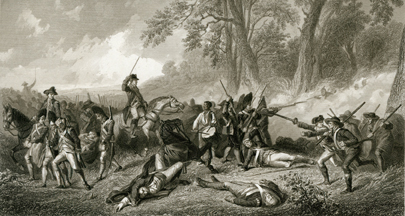
| "The Fall of Braddock," painted by C. Schuessele, engraved by J.B. Allen, and published circa 1859 by Virtue, Emmins & Co., New York. Battles of America By Sea and Land, by Robert Tomes. |
|
|
| "Defeat of Braddock," published on the 100th anniversary of the battle. Ballou's Pictorial (July 7, 1855) |
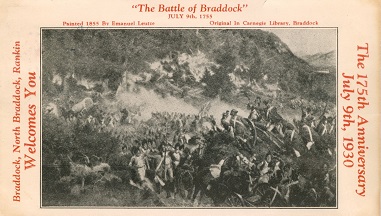 |
| The Battle of Braddock, painted in 1855 by Emanuel Luetze, with the original purchased in 1911 for the Carnegie Library of Braddock, PA. The image was used on an envelope marking the 175th anniversary of the battle on July 9, 1930 |
|
|
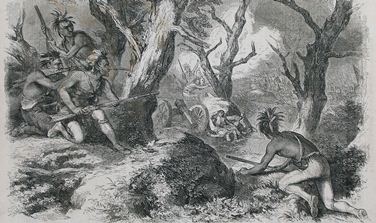
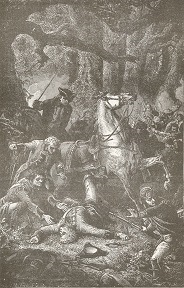
| Above left: "Defeat of General Braddock in the Indian Ambush," painted by "C.B."Cassell's History of England, Vol. IV (1888). Right: The Braddock Massacre," from the original drawing by H.A. Ogden. The History of Our Country, by Edward S. Ellis, A.M. New York and Los Angeles: R.H. Whitten Company (1900) |
|
|
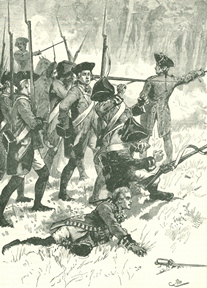
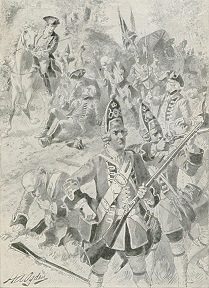
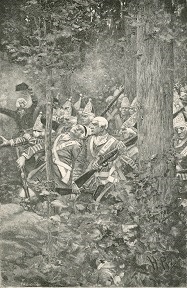
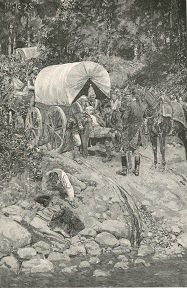
| Above left: "Seeing no enemy, they themselves falling every moment from the fire," drawn by Howard Pyle, engraved by F.S. King. Scribner's Magazine (May 1893). Right: "The Death of Braddock. G.W. placed the General in a small covered cart," drawn by Pyle, engraved by C.W. Chadwick. Scribner's Magazine (May 1893) |
 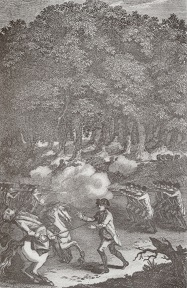 |
| Above left: "Death of Braddock." (Columbus and Columbia: A Pictorial History of the Man and the Nation, Vol. III - by Prof. John Clark Ridpath). Right: Defeat and Death of Gen. Braddock." The South in the Building of the Nation - Julian Alvin Carroll Chandler, editor (1909). |
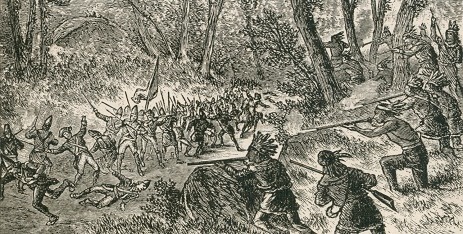 |
| Above: "Defeat of Braddock." Life of Washington by Washington Irving, Farm and Fireside Library, May 1896. |
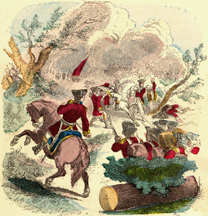 |
| Washington in battle when Braddock fell. The Illustrated Life of Washington, by the Hon. J.T. Headley (1860). |
|
|
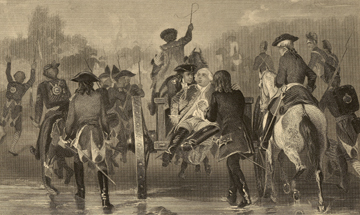
| The dying Braddock retreats to the mountains above Uniontown, where he dies July 13. Steel engraved print published by Johnson & Miles, New York, based on the original painting by Alonzo Chappel. Our Country. A Household History for All Readers, by Benson J. Lossing, LL.D. (New York: Henry J. Johnson, 1879). |
|
|
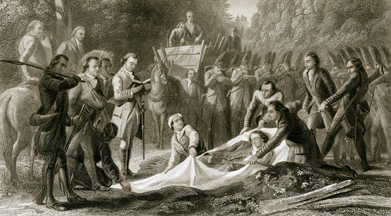
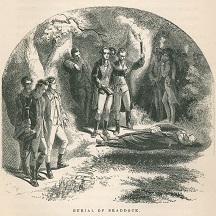
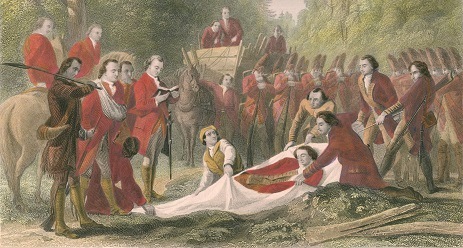
| Above and below: "Burial of General Braddock," painted by John Mc. Nevin, engraved by John Rogers. Washington and the American Republic, by Benson John Lossing. (Virtue, Emmins & Co., New York, 1858). |
 |
|
|
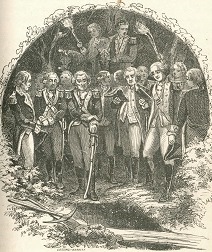
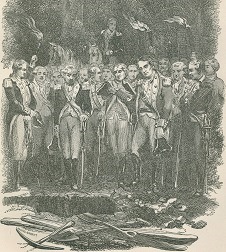
| Left: "Burial of Braddock" wood engraving. Illustrated Life of George Washington, by Hon. J.T. Headley. New York: G. & F. Bill, 1860. Right: "Burial of Braddock." Pictorial Life of George Washington, by J. Frost, LL.D. Philadelphia: Thomas, Cowperthwait & Co., 1848; republished in Illustrated History of Washington and His Times, by Rev. William Hutchison, A.M., Norwich, CT: published by Henry Bill, 1868, |
  |
| Left: "Burial of Braddock." Primary History of the United States by Benton Lossing. New York: Sheldon & Company. Right: Slightly different version in a book by the same author. A Centennial Edition of the History of the United States, by Benton Lossing, Hartford, Connecticut, Thomas Belknap, 1876. |
|
|
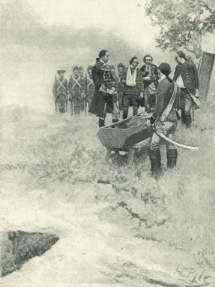
| "The Burial of Braddock" painted by Howard Pyle, depicting George Washington, "Gage" and "Gates." Harper's New Weekly Magazine (1896) |
|
|
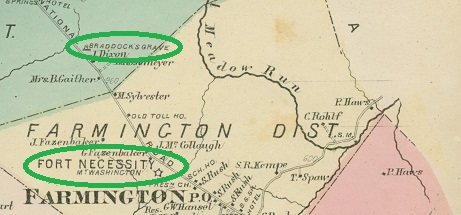
| Location of Braddock's Grave and Fort Necessity as shown on the 1872 Fayette County Atlas page for Wharton Township. |
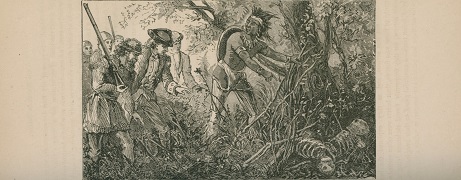 |
| Major Sir Peter Halket discovering the skeletal remains of his father and brother at the Braddock battlefield site. Our Western Border, 100 Years Ago, by Charles McKnight (Philadelphia: J.C. McCurdy & Co., 1876). |
~ Capture of Fort Duquesne, Pittsburgh, 1758 ~ |
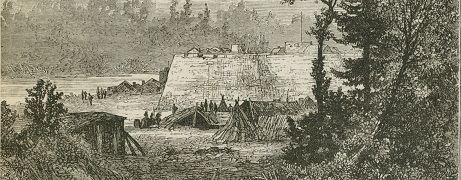 |
| Fort Duquesne in what today is Pittsburgh, the last of four forts built by the French in 1753-1754 in a chain starting at Lake Erie. The fort was the object of English army attacks under General Edward Braddock in 1754 and General John Forbes in 1758. Cassell's Illustrated History of the United States, by Edmund Ollier (1890). |
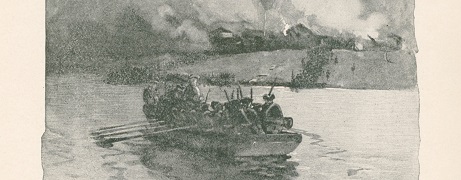 |
| French troops burn and abandon Fort Duquesne on Sept. 14, 1758 after an attack by English forces under General John Forbes. After taking possession of the site, the English constructed a new, much larger version called Fort Pitt. The National History of the United States, Lamson & Carpenter (1899). |
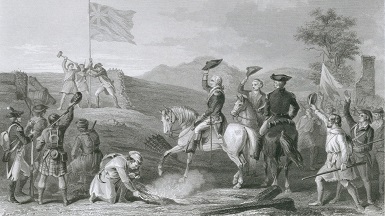 |
| "Washington Raising the British Flag at Fort Duquesne." Washington and the American Republic by Benson John Lossing. Drawn/engraved by J.R. Chapin and T.B. Smith. New York: Virtue, Emmins & Co. (1859). |
~ Rediscovery and Reburial of Braddock's Body ~ |
|
|
| Original road east of Braddock's grave. (No. 36, Braddock Road Series by John Kennedy Lacock, Amity, PA. E.K. Weller, Washington, PA.) |
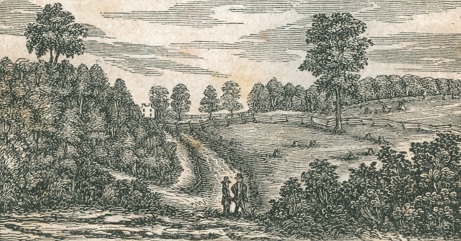 |
| Contemporary sketch of the gravesite. Historical Collections of the State of Pennsylvania by Sherman Day (1843). |
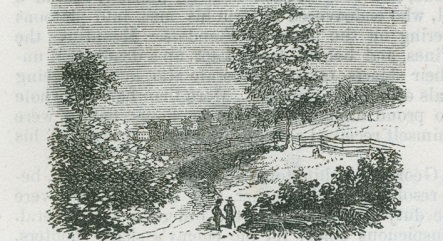 |
| Similar but different drawing than above. Our Whole Country, Or, The Past and Present of the United States, Historical and Descriptive, by John Warren Barber, New York City: George F. Tuttle and Henry M'Cauley, 1863. |
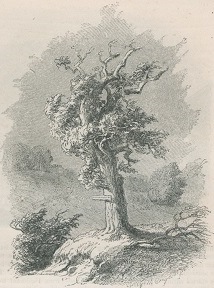 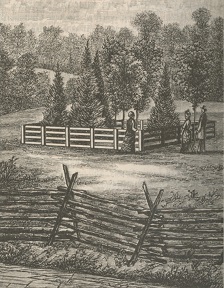 |
| Above left: For many years, Braddock's grave was only marked by a board nailed to this tree. Harper's New Monthly Magazine (1857). Right: the now-fenced gravesite. History of Fayette County by Franklin Ellis, 1882. |
|
|
| Braddock's grave one mile east of Chalk Hill beside the National Pike. (No. 34, Braddock Road Series by John Kennedy Lacock, Amity, PA. E.K. Weller, Washington, PA.) |
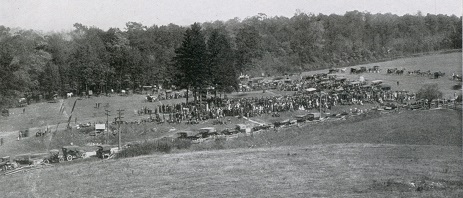 |
| Dedication of the new monument, 1913. Fort Necessity and Historic Shrines of the Redstone Country. Fort Necessity Chapter, Pennsylvania Society of the Sons of the American Revolution, Uniontown, PA, 1932. |
 |
Motorist walks the grave site, 1910s or 1920s |
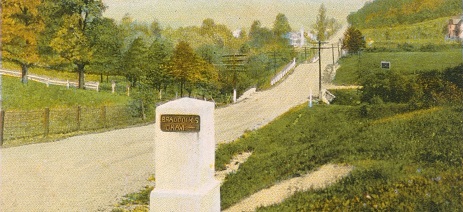 |
Roadside sign points to "Braddock's Grave" |
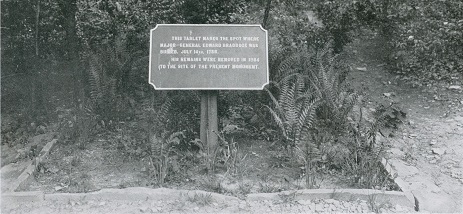 |
| Signage at the site of Braddock's original grave before the remains were removed to the permanent location. Fort Necessity and Historic Shrines of the Redstone Country. Fort Necessity Chapter, Pennsylvania Society of the Sons of the American Revolution, Uniontown, PA, 1932. |
|
|
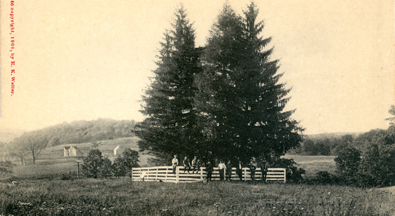
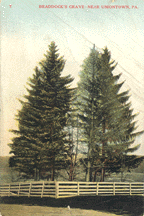
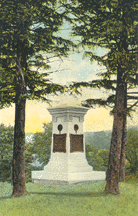
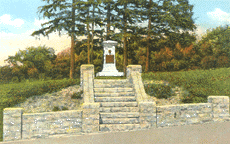
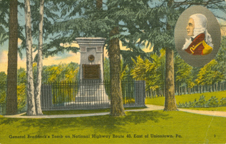
| Above left: Braddock's Grave prior to erection of the granite monument. (Kwin & Co., Chicago, Publisher.)Center: New granite monument in blue and black tinting, published as part of the Old Trails Series by Thos. J. Jacobs Jr. Right: Newly installed monument. (I. Robbins & Son, Pittsburgh, Publisher.) |
|
|
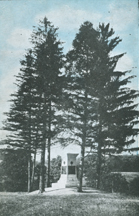
| Above left: Braddock's grave monument with steps from the National Pike. (I. Robbins & Son, Pittsburgh, Publisher.) Right: the obelisk. |
|
|
|
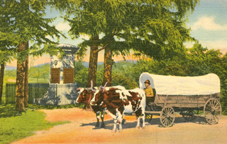
Popular postcard views of the gravesite. |
|
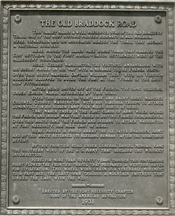
Above left: Braddock's Road plaque, erected 1931 by the Sons of the American Revolution, Fort Necessity Chapter.Right: Fort Necessity plaque, placed in 1932 by the Daughters of the American Revolution, Great Meadows Chapter. |
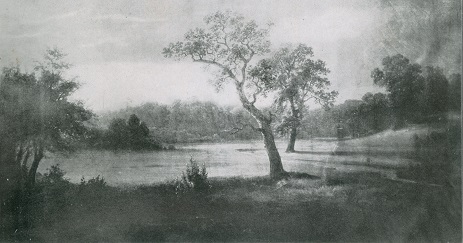 |
| Site of Fort Necessity. Painting by Paul Weber, 1854. Fort Necessity and Historic Shrines of the Redstone Country. Fort Necessity Chapter, Pennsylvania Society of the Sons of the American Revolution, Uniontown, PA, 1932. |
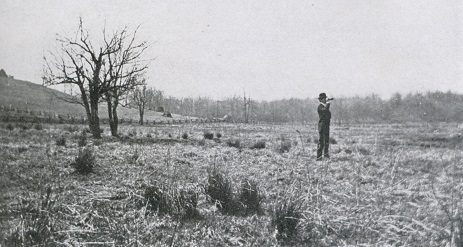 |
| Site of Fort Necessity, 1890. Fort Necessity and Historic Shrines of the Redstone Country. Fort Necessity Chapter, Pennsylvania Society of the Sons of the American Revolution, Uniontown, PA, 1932. |
|
Site of Fort Necessity at Great Meadows, in the early 1990s, before the fort was rebuilt. |
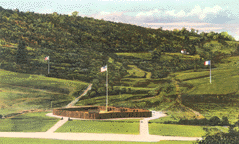  |
| Above left: an early square reconstruction Fort Necessity, site of Washington's first real battle and surrender in 1754. Right: Cabin used as a first aid station during the battle, sited in the middle of the fort. (Minsky Bros. & Co., Pittsburgh, Publisher.) |
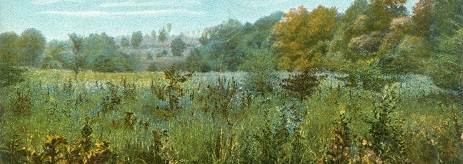 |
Clara Holt's farm circa 1908, containing the "Camp of the Twelve Springs,"where Washington camped in 1754 and Braddock in 1755.
|
|
Copyright © 2002, 2006, 2009-2011, 2014-2020 Mark A. Miner |