
|
Ida (Gribble) Groves King |
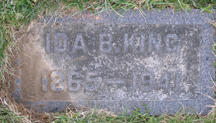 |
| Fairview Cemetery |
Ida (Gribble) Groves King was born on Nov. 25, 1865 in Merrittstown, Fayette County, PA, the daughter of Henry Harrison and Mary Catherine (Fawcett) Gribble. Her second husband was a veteran of the Civil War.
As a baby, Ida later wrote, she moved with her family back to their ancestral home region, "to a farm near Pisgah, Grant District, Preston County," where she grew to womanhood. "I lived with them until the death of my father when I was a young woman. My mother, brothers and sisters lived on the farm until my [first] marriage..."
Ida was married twice. Her first husband was Ira F. Groves (1868-1942), the son of Gene and Senith Ann (Everly) Groves. They resided at Pisgah, Preston County. The Clarksburg (WV) Telegram said Ira was "an early teacher." They had three known children -- Victor Lloyd Groves, Marie G. Menear and Pearl Freeman.
After a few years of marriage, Ira sued for divorce on grounds that Ida had been unfaithful. After reviewing the evidence, the Preston County Circuit Court agreed and granted the divorce on Dec. 17, 1898. Ida then went back to using her maiden name for several years.
On March 14, 1901, at the age of 36, Ida married her second husband, 58-year-old widower Eugenus B. King (1843-1933). He was a native of Pisgah and the son of Thomas and Jane (Brandon) King. Rev. E.P. Idleman performed the ceremony at Bruceton Mills, Preston County.
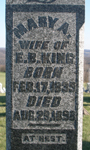 |
| Eugenus' 1st wife |
Eugenus had been married once before, in 1867, to Mary Smith (1839-1898), the daughter of Josiah and Jane (McLean) Smith. They had no children. Mary died at age 59 on Aug. 29, 1898, and was buried at Fairview Cemetery, two miles east of the village of Pisgah, near Bruceton Mills, Preston County. Among those known to have attended the funeral were Lorene Benson and C.R. Michael of Bruceton Mills. Her tall, upright grave marker -- seen here -- was easy to find when photographed in April 2007. Today, the small community of Pisgah abuts the eastern edge of what is now Coopers Rock State Forest.
Eugenus stood five feet, six inches high, weighed 165 lbs., and had a fair complexion, blue eyes and dark hair. During the Civil War, on Feb. 14, 1865, Eugenus enlisted in the U.S. Army, as a member of the 17th West Virginia Infantry, Company I. Two of his brothers -- Albert and William King -- were soldiers who starved to death as Confederate prisoners of war in the notorious Andersonville Prison, and another brother George King served in the First West Virginia Cavalry. Eugenus served with the 17th WV for four and a half months. In late February or early March 1865, he contracted a case of the mumps while on duty at Wheeling, WV. He remained with his regiment during the duration of the war and was discharged at Wheeling, WV on June 30, 1865, after the Confederate Army had surrendered.
The Kings were farmers in and around Preston County, including at Pisgah, Bruceton Mills and Rockville. . Ida was a housewife, but little is known about her. Over the years, Eugenus wartime ailments caused him increasing physical discomfort, primarily rheumatism, heart disease and hemorrhoids, as well as failing eyesight as he aged. In 1889, he also developed problems with his spine. When the federal government began awarding pensions to Civil War veterans circa 1890, he submitted paperwork and was awarded monthly payments of $8.
 |
Bruceton Mills, WV, along the Cheat River, early 1900s |
Eugenus often worked together in farming with neighbors such as Evan King and W.M. Gibson, who "very often" heard him complain of his heart and hemorrhoids. Recalled Gibson, "I have often seen him when it was impossible for him to do any kind of manual labor on account [of his disabilities]. I knew him to try to work when it seemed he would drop over at any time from heart trouble."
The pension payments were increased from time to time. As an 87-year old some decades later, his payment was raised from $72 to $90 per month. Government field representative William H. Wentz interviewed him at home in June 1930 and reported the following:
When I called to see the claimant he was out in his yard and had in his hand a cane which he was using to feel his way and his actions were just as is common for any blind man. He told me he could see my body when I moved but could not make out my features or to tell a man from a woman. In the house I picked up a soap bob with late letters some 2 inches high and he could not read them at all at any distance and could not count my fingers but can tell day from night... He says that up to within the last few weeks he considered that his vision was useful for he could see well enough to aid him in getting about the house and about eating his meals but for one month his vision has almost -- he has only been able to tell day from night.
To fulfill his obligations as a pensioner,
Eugenus underwent an annual physical examination led by a board of examining
surgeons. One physician reported in 1928 that Eugenus' eyes "are gradually
failing. He is unable to read, or recognize faces or small objects. He is also
subject to dizzy attacks on arising. A regular attendant is required to prepare
meals, aid in walking during dizzy attacks, also in aiding patient in
recognizing small objects." In his examination in January 1929, he was
found to have "no natural teeth" left. His pulse rate was 84,
respiration 24, and with blood pressure of 160/80.
Book naming the Kings
In 1933, Eugenus and Ida were mentioned in a book published about his family, Genealogy of Some Early Families in Grant and Pleasant Districts, Preston County, West Virginia, authored by Edward Thorp King, of Marshalltown, Iowa. Ida obtained her own copy following publication. Eugenus and his parents and siblings are mentioned in a profile of a nephew Thomas Winfield King in The History of West Virginia, Old and New, published in 1923 by the American Historical Society, Inc. (page 387). The latter volume has been reprinted on RootsWeb, with an original copy in the West Virginia and Regional History Collection at West Virginia University.
Eugenus died just a few weeks shy of his 90th birthday on May 6, 1933, in Preston County. He was buried at Fairview Cemetery, near his first wife, and beside where his second wife would eventually rest. Ted Groves was the informant for his official death certificate.
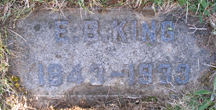 |
| Eugenus' grave, Fairview Cemetery |
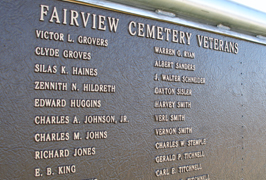
Today, Eugenus's flat grave marker is in danger of being obscured by moss and overgrown grass. It had to be cleared before it could be photographed. A separate plaque at the cemetery identifies Eugenus -- named as "E.B. King" -- among U.S. military veterans buried there.
Ida successfully petitioned the U.S. Veterans Bureau to receive Eugenus' pension payments. Among the friends who provided supporting testimony on her behalf were Emma C. Bowermaster of Bruceton Mills, Pearl Spiker of Bruceton Mills, As of 1936, she received $30 per month in payments.
In March 1934, Ida was living or visiting with "K. King" in Sacramento, CA, at 826 17th Street, but later returned to West Virginia. In March 1937, she was notified that her monthly pension payments would increase to $40, retroactive to November 1935. Thus she would have obtained a lump sum payment for the accrued amount around that time. In late 1940, Ida went to live in the home of her married daughter, Pearl Freeman, at 115 Willison Street in Clarksburg, Harrison County, WV.
 |
|
Eugenus's name, lower left, on a modern plaque the Fairview Cemetery near Pisgah |
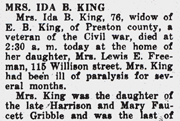 |
| Obituary, 1941 |
At the time of her death in 1941, she was the last of 13 brothers and sisters, and had lost her sister Emma Shaw and brother Arley to death within the previous six months.
Ida passed away of chronic myocarditis and hardening of the arteries just eight days after her 76th birthday, on Dec. 3, 1941, and just four days before our nation was attacked at Pearl Harbor and plunged into World War II. She was buried at the Fairview Cemetery, following a funeral service at the Bruceton Mills Methodist Church. Ida's parents, brother Arley Gribble and sister Jennie Christopher also rest for eternity at Fairview.
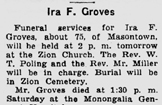 |
| Morgantown Post, 1942 |
In the early 2000s, efforts to find Eugenus' Civil War pension records at the National Archives were unsuccessful. Family researchers were told that the files were not in the possession of the Archives but rather the U.S. Department of Veterans Affairs. In June 2009, the records were requested under the Freedom of Information Act and were thus located in the VA Regional Office in Baltimore. The VA provided this website's founder with a full set of copies in September 2009, and they now are a permanent part of the Minerd.com Archives.
[Note -- Ida's first husband, Ira F. Groves, went on to remarry Grace First. They made their home in Masontown, Preston County. He died in Monongalia County, WV on June 6, 1942, with burial at Zion Cemetery. His obituary was printed in the Morgantown Post.]
~ Daughter Marie (Groves) Menear ~
Daughter Marie Groves (1896-1969) was born in 1896.
On June 22, 1918, in Richmond, VA, she married
Nacy Perry Menear (Nov. 9, 1890-1981), a native of Austen, WV and the son of McCellan and Nancy Alice Menear. He stood 5 feet, 8 inches tall and weighed 148 lbs.
They together bore one son, James Gordon Menear.
When required to register for the military draft in 1917, he disclosed that he worked as a machinist for Hazel Atlas Glass Company at its plant in Clarksburg, WV. He remained with Hazel Atlas for decades, specializing in mold-making.
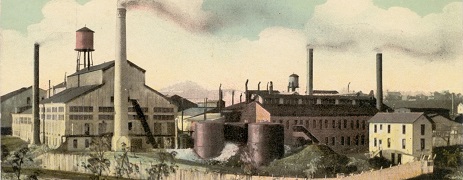
Hazel-Atlas Glass plant in Clarksburg, WV, Nacy Menear's workplace
Nacy served in the U.S. Army during World War I. He was deployed to France in early October 1918. After the war's end, he remained in Europe and sailed home in May 1919, on the ship Manchuria, arriving in the Port of Hoboken, NJ.
The Menears resided at 314 Elm Street in Clarksburg circa 1941-1967
Marie was a Republican committee woman in Clarksburg for several years. She also
was a member of the First United Methodist Church and the Queen Esther OES of
the Ladies Auxiliary of Roy E. Parrish Post 13, Lucinda Rose Auxiliary of the
Veterans of Foreign Wars.
She
suffered with hypertension for many years. On Jan. 7, 1969, Marie passed away at
the age of 73. She was laid to rest in the Sunset Cemetery in Mt. Clare, WV.
Nacy lived for another dozen years after his wife's demise. He died on Jan. 6, 1981.
Son James Gordon Menear (1928-1967) was born on July 21, 1928 in Clarksburg. He stood 5 feet, 6½ inches tall in young manhood and weighed 135 lbs. At the age of 18, he lived at home and was employed by Standard Advertising Company in Clarksburg. He is known to have served in the U.S. Army during World War II. On Aug. 31, 1957, at the age of 29, James was united in matrimony with Nancy Kay Hoyt (Oct. 23, 1937- ? ), daughter of Charles E. and Helen I. Hoyt of New Martinsville, WV. Rev. Donald Dewitt Swift led the wedding ceremony, held in Fairmont. Together, they produced two sons -- James Gordon Menear Jr. and Philip Charles Menear. The couple later divorced. Circa 1967, he was employed as a band instructor and teacher at Lumberport High School near Shinnston, WV. His address at that time was his parents' home at 314 Elm Street. Tragically, he was severely injured at the age of 38 on June 6, 1967 -- on the day of the school's commencement -- in a two-vehicle collision north of Gore, WV along U.S. Route 19. He was rushed to St. Mary's Hospital, where he died of massive head injuries. The news was distributed by the United Press International and published in the Raleigh (WV) Register and Charleston Daily Mail.His remains were laid to rest in Clarksburg's Sunset Memorial Park.
~ Son Victor Lloyd Groves ~
Son Victor Lloyd Groves (1891-1957)
was born on May 25, 1891 in Pisgah, Preston County.
He dwelled in young manhood in Bruceton Mills and Morgantown, WV. When required to register for the military draft in 1917, he dwelled in Morgantown and worked as a driver for Morgantown Ice Company. He also spent three years as a corporal in the West Virginia National Guard.
At the age of 28, on Sept. 25, 1918, he entered into marriage with 22-year-old Rena Deal ( ? - ? ). The wedding was led by Rev. T.E. Gainer of the United Brethren Church of Kingwood.
He served for
six and a half months in the U.S. Army during World War I. He was a member of
Company A, 2nd Development Battalion, 155 Depot Brigade, and was discharged
following the Armistice on Dec. 12, 1918.
After his return home, he lived in
Bruceton Mills circa 1933 and later moved to 804 Locust Avenue
in Clarksburg. The federal census enumeration of 1940 shows Victor now married to Anna Virginia ( ? - ? ), who was 14 years younger than he. Their home was in Clarksburg, where he earned a living as an automobile salesman and she as a public school teacher. The pair eventually divorced.
Victor again registered for the military draft in 1941 as World War II loomed. He was unemployed at the time and resided in Bruceton Mills. His final address was 115 Willison Street, Clarksburg, and his final occupation was as a hotel manager..
With his health in decline, due to heart disease, Victor was admitted to the Veterans Administration Center in Martinsburg, Berkeley County, WV. He remained for a year until his passing at age 65 on May 9, 1957 from congestive heart failure. His remains were brought back to his birthplace for burial in Fairvieew Cemetery.
 |
|
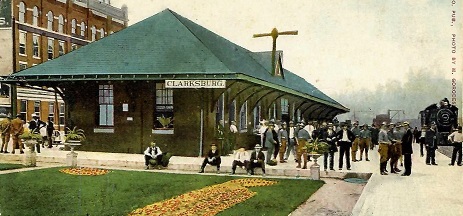
Railroad station in Clarksburg |
~ Daughter Pearl (Groves) Freeman ~
Daughter Pearl Groves (1893-1989) was born on Aug. 7, 1893 in Preston County.
When she was 22 years of age, on July 5, 1916, she was joined in the bonds of wedlock with 21-year-old Lewis Emmett Freeman (July 22, 1896-1962), the son of Charles F. and Mary (Moffett) Freeman. The wedding ceremony was held in Bruceton Mills by the hand of Rev. W.W. Morris of the Methodist Episcopal Church.
They resided at 407 Roosevelt Road in Grafton, Taylor County.
They produced two known offspring, Renick Eugene Freeman and Yvonne Goodwin.
Lewis was a machinist
in Clarksburg for many years.
He suffered from heart disease and died at the age
of 66 on Dec. 11, 1962. Burial was in Sunset Memorial Park in Clarksburg.
Pearl outlived her husband by more than a quarter of a century. Death enveloped her at age 95 on Feb. 3, 1989.
Son Renick Eugene Freeman (1926-1971) was born on June 10, 1926 in Fairmont. He served in the U.S. Naval Reserve during World War II. After the war's end, he returned home to Clarksburg. He married Patricia Fowble (July 24, 1931-1957), daughter of Howard and Catherine (Nutter) Fowble of Akron, OH. They are known to have been the parents of Michael Freeman and Glenn Wayne Freeman. For the last six years of her life, Patricia suffered from bronchial problems. While a patient in Frick Memorial Hospital in Mount Pleasant, PA on Nov. 17, 1957, at the age of 26, she died from the effects of influenza and pneumonia. Her remains were lowered into repose in Sunset Memorial Park, Clarksburg. Then on Dec. 12, 1959, at age 33, he wed a second time to 35-year-old Louise Virginia (Harrison) Hamilton ( ? - ? ), daughter of John Henry and Edith May (Stonebraker) Harrison. The second marriage lasted for less than five years, and the pair divorced in Lee County, FL in July 1964. He succumbed to the spectre of death on March 31, 1971.
Grandson Michael Freeman wed Alice. They have made a home in Bridgeport, WV.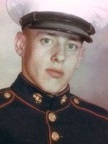
Glenn W. Freeman
- Grandson Glenn Wayne Freeman (1947-1968) was born on Dec. 3, 1947. He grew up in Bridgeport near Clarksburg. He joined the U.S. Marine Corps during the Vietnam War. He held the rank of corporal. Tragically, he was among 46 crewman and passengers who were killed in the Quang Tri Province of Vietnam on Jan. 8, 1968, when the helicopter CH-53A in which they were riding crashed into a mountain and burned. The site is said to be 18 miles south of DaNang. The tail number of the craft reputedly was 153710. The group's remains were recovered and returned to the United States for mass burial in Jefferson Barracks National Cemetery in Lemay, MO.
Daughter Yvonne Freeman ( ? - ? ) was born in (?). She married (?) Goodwin.
|
Copyright © 2006-2010, 2016, 2018, 2021- 2022 Mark A. Miner |
|
We are grateful to the Department of Veterans Affairs in Baltimore for providing a copy of Eugenus B. King's Civil War pension file. Glenn Wayne Freeman image courtesy of the Freeman family via the Vietnam Veterans Memorial Fund (www.vvmf.org). |