
|
Mary Jane (Miner) Alderman |
Mary Jane Miner was born in about 1835 near Champion, near Warren, Trumbull County, OH, the daughter of Joseph and Elizabeth (Forney) Miner.
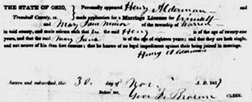
Mary married William "Henry" Alderman Sr. (1833-1905). He was the son of Daniel and Mary Ann (Durans) Alderman, and was born in Cheshire, CT. The wedding took place on Dec. 3, 1857, in Warren. Mary Jane was age 22 at the time of marriage, and he was 24. Their marriage application from Trumbull County is seen here.
 |
|
Mary Jane and Henry's marriage
license |
The Aldermans produced a brood of two known sons – William "Franklin" Alderman and William "Henry" Alderman Jr.
Henry stood 5 feet, 9 inches tall, with sandy complexion, blue eyes and sandy hair. He was a farmer.
During the Civil War, Henry went to Cleveland to enlist in the Army. He joined the 8th Ohio Infantry on June 19, 1861, under the command of Capt. Kerney. Henry was assigned to Company B. He was first an infantryman, but after becoming ill with "rheumatism," he was detailed as a teamster (wagon driver) in August, while stationed at Camp Pendleton.
The following month, the regiment was assigned "among the mountains" of West Union, Doddridge County, WV, "along the Baltimore and Ohio Railroad, where the men suffered severely from fever," said the book, General History of Cuyahoga County. "At 'Maggetty Hollow' over three hundred were in the hospital, and thirty five deaths resulted in a short time."
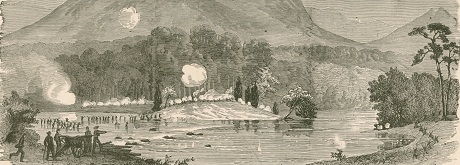
The regiment saw action later in 1861 and early 1862 in Romney, Hanging Rock, Blue's Gap, Bloomey Gap, Cedar Creek and Strasburg in West Virginia and Virginia. Said the Cuyahoga County history, "The regiment was deployed as skirmishers before and after the Battle of Winchester. The killed and wounded during this battle was more than one-fourth of its number."
 |
|
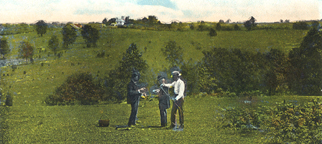
Above: sketch of the Battle of Cedar Creek. Below: the battlefield some decades after the Civil War ended, showing Belle Grove house in the distance. |
|
|
While on a march from Pendleton to Grafton, WV about the first of September 1861, Henry's leg was broken in a freak accident. Writing about himself in the third person, he stated: "His team & wagon got mired or stuck (swamped) in the mud & while he was trying to extricate them he was [run over] by the wheel of the wagon on the left leg below the knee, injuring and fracturing the front bone of the leg & fracturing the ankle joint, that there was nothing done for the same but what he doctored it himself."
Henry bitterly wrote the following, many years later:
I went 3 or 4 times to my regimental dockter and told him how I was how I felt and he told me to go to my quarters that all I wanted was to get excused. There was not a man that worked more than I did. I was detailed as wagon master and worked night and day ... untill we got to Fredericksbur V. and thare the men built a shanty of logs in the bank and thare I grew wors and my Captain Wm. Kinney was sent for... The reason I did not receive treatment by Regimental Surgeon for nearly a year prior to going to Hospital was because I was detailed to care for Wagon train & there was no Regt'l Surgeon with us, & in trying to be nervy & hold out, to the end, I did not give up as sick until I was "played out" entirely...
Henry also began to suffer heart palpitations and later kidney problems after he "had been given charge of 16 wagons & rode on horse back, and as my leg was so swollen and pained me so that instead of letting my legs hand down, I rode with my left leg on top of the horse on a blanket, & by riding in this position, the back of the saddle injured by back and kidneys, this was during the fall of 1862. I continued to ride in this manner & care for or look after the 16 teams until my leg, heart, kidneys & hydrocele became so bad that I was taken down entirely sick & used up.

|
|
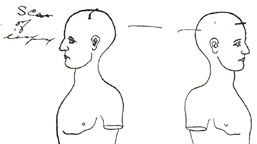
Surgeon's sketches of Henry's wounds to his scalp and leg - National Archives |
Fellow soldier and teamster Henry G. Thirwachter was an eyewitness to another serious injury that Henry suffered. Thirwachter wrote: "I was present at Newport News in the the first part of September 1862 when [Henry] was hurt by being kicked with a mule and saw him where he was kicked in the head which was cut badly by the mules' shoe and at the same time he was kicked in the groin."
George W. Crosley also saw the injury take place, and said the kick of the mule "was 3 inches, the cut being through the scalp and deep enough to reach the scull." He also noted that the mule's kick to the groin caused a hydrocele, a buildup of fluid in the scrotum. "I helped carry him back and wash him up," Crosley wrote. "He stayed with the wagon train until we got to Falmouth, Va., some time in December 1862 just after the battle of Fredericksburg when he was sent to the hospital."
~ A Heroic Stand at Antietam ~
 |
|
Among the thousands of dead in Antietam's Bloody Lane (National Archives) and the 8th Ohio Infantry monument at the site |
  |
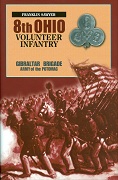
The 8th Ohio was part of Brig. Gen. Nathan Kimball’s command as part of a division led by Brig. Gen. William H. "Old Blinky" French. Writing in Landscape Turned Red, author Stephen W. Sears says that French "relentlessly drove the last of his Federal brigades into savage battle. ... The Ohio and Indiana boys, in fact, could make the singular boast that back in March, at Kernstown in the Shenandoah Valley, they had taken on Stonewall Jackson and actually beaten him." Early that morning at Antietam, after the 8th Ohio was ordered into motion, they passed through the farm of William Roulette. For a time, the man stood outside of his farmhouse, cheering on the federals and waving an old white hat. Then when instructed to attack, Kimball rode past his brigade and shouted out, “Now boys, we are going, and we’ll stay with them all day if they want us to.” When Kimball’s he ordered his brigade to make a slight left wheeling turn, the 8th Ohio had to climb over Roulette’s nicely painted fences along the Sunken Road. Heavy firing broken out, and Sgt. Francis Galwey of the 8th Ohio gaped as his comrades dropped all along their line. Another of the regiment, Lt. Azor Nickerson, recalled the onslaught of “terrible discharges of grape canister, while the bursting of heavy shells from a battery directly in our front, would create a juvenile earthquake about the head.” The men of the 8th Ohio were openly exposed while occupying a more level spot than the other regiments. Writing later, Capt. Benjamin F. Ogle of the 8th Ohio, remembered that his 1st Lt. George S. Smith lost his left eye and cheekbone but might recover, while Lt. Creighton Thompson was hit in both eyes and was expected to die. In his book I Dread the Thought of That Place, D. Scott Hartwig writes that “The 14th Indiana and part of the 8th Ohio, on the hill west of the Roulette farm lane, were the most visible to Grime’s gun crews and drew most of their fire. The position of Maurin’s and Huger’s batteries enabled them to deliver an oblique, almost enfilading fire on the Hoosiers and Buckeyes, which was particularly destructive.” Galwey of the 8th Ohio noted that in this enfilade of gunfire, “it seems as though nothing could live through it.” He went on to say that “The din is frightful. Alas, no words can depict the horrors of a great battle as they appear to men unaccustomed to them. We had seen a great deal of service before now; but our fighting had been mostly of the desultory, skirmishing sort. What we see now looks to us like systematic killing.” The 8th Ohio eventually took possession of ground it had spent 90 minutes trying to capture. Writes Hartwig, “The carnage they encountered in the lane shocked everyone.” Then in a Confederate counter-attack, Kimball ordered the 8th Ohio to turn and face the rebels, who were coming from the eastern end of an adjacent cornfield owned by Samuel Mumma. Thomas Loundsdale, a member of the 14th Indiana, saw the enemy make a charge and “pass on the double quick their southern crosses spread to the breeze, a more hateful sight I never want to see.” At this point the 8th Ohio had perhaps 60 men still standing, with each only holding three to four cartridges. The attackers “peppered us unmercifully,” wrote Galwey. Author Sears adds that on the counter-surge, Cooke’s rebels “penetrated deeply into the flank of the Yankee lines facing the Sunken Road, catching them unprepared. There was no panic to sweep away their ranks, however. Brigadier Kimball of French's division swung around two of his veteran regiments, the 8th Ohio and 14th Indiana, to take the charge." Between 1 p.m. and 2 p.m. the 8th Ohio finally was relieved. Writing in his volume 8th Ohio Volunteer Infantry, Franklin Sawyer says that:
...our brigade withdrew and formed under cover of the ridge and the Roulett buildings, having held our battle line, being nearly all the time under a terrible fire for over four hours... The loss in the brigade had been fearful. In the Eighth 162 officers and men had been killed and wounded, or about half the number engaged... But the brigade had achieved undying renown. It had taken and held one of the difficult and important positions on the field, and had maintained an unwavering line during the carnage of a four hours' battle. Gen. Sumner pronounced it the "Gibraltar Brigade." In December 1862, Henry was admitted to the Second Ward Hospital in Alexandria, VA, near Washington, DC. A medical inspector wrote that his illness resulted "in very great enlargement of the knee and ankle joints of the left limb" and that this rendered Henry totally unfit for further military service. Just after the new year, on Jan. 3, 1863, while at Campbell Hospital in Washington, he received an honorable discharge, and began the voyage back home. His regiment went on to major action at Antietam, Chancellorsville, Gettysburg and The Wilderness, among many other battles. Upon his homecoming, Henry began a long recovery. "The first year after arriving home the leg was badly swollen," he wrote, "and very painful inasmuch that I was compelled to use crutches which were used about one year and since that time [I] have been able to get around a greater part of the time without them." ~ A Return to Civilian Life ~
The Aldermans resided in Braceville and Warren, Trumbull County, immediately after the war. In February 1866, Henry filed a civil action
against his father in law in the Court of Common Pleas of Trumbull County. The
details about the dispute are not yet known, but within a few weeks, Henry
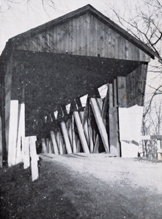
agreed to have the case dismissed. Old covered bridge, Braceville Seen here is an old
covered bridge in Braceville which the family likely would have known and
traveled across. The structure spanned the Mahoning River west of Warren. Later, the Aldermans migrated to Indiana,
where they were residing in Jamestown Township, Steuben County at the time
the federal census was taken in 1870. Their residence was just a few miles from
the Michigan state line. In the 1870 census, Mary was marked as
being unable
to read. Sadly, Mary died at age 38 on Feb. 16, 1871,
in Nevada Mills near Jamestown, Steuben County. Friend Salmon Parker of Nevada
Mills once wrote: "I was a near neighbor of William H. Alderman and his
first wife Mary Alderman since the year 1867 and I distinctly recolect the death
of Mary Alderman in February 1871 and was one of the Pall Bearers at her
Funeral." Parker's wife Caroline wrote that she "was at their house
and helped take care of her in her last sickness and was present at her Death
and at her Funeral." Henry Webb of Angola wrote that he was
acquainted with Henry and Mary and "was at their home during her last
sickness, and at her Funeral." On Jan. 14, 1872, at age 38, Henry married his second wife,
33-year-old Desdemona (Baird) Briggs (1836-1909). The ceremony took place a few
miles over the state line at Arnolds Corner, Gilead, MI, performed by Emanuel
Gilbert, a justice of the peace. Witnesses were James and Julia Gordon of
Steuben County. Desdemona was a native of
Ohio, with her father from Vermont and her mother from New Jeresey. In an
interesting twist, she had divorced her first husband, William H. Briggs, in Steuben
County, IN, about one week before she married our Henry Alderman. The Briggses' divorce decree
is on file in the Circuit Court Office of the Steuben County Courthouse. The Aldermans went on to have two more sons
-- Simeon Miles Alderman and Lewis A. Alderman. While
in Bronson, the Aldermans continued farming, though it is not known if they
purchased any land outright. Henry also was a loyal member of the local Hackett
Post of the Grand Army of the Republic, a national organization of Union Army
veterans. Wells Knapp, the commander of the post, once wrote: "I was
accustomed to meet William H. Alderman nearly every week for a number of years
in the regular meetings of our Bronson Grand Army Post and that he was in my
store about every week for a number of months." In March 1886, the members
of the post signed a certificate stating that Henry was "a poor man with no
visible means of support and also know he is disabled that that extent this --
he is unable to do any manual labor to speak of. He has no family
physician." He is known to have attended a GAR
encampment in Cleveland, OH in the fall of 1901, where he saw members of his old
regiment, Henry G. Thirwachter, of Lipsic, OH and Joseph Evans of Cleveland.
Wrote Evans: "He is nearly blind and has to be led about." As he aged, he was increasingly unable to
work and thus earn an income. In November 1877, he began receiving federal
pension payments of $6 per month as compensation for his wartime injuries. Over
the years, at regular intervals, he filed appeals for increases, most of which
were rejected due to lack of hard evidence. History of the 8th Neighbors Monroe Maybee and Squire Bard
testified that they knew Henry well, had been frequent visitors to his home, and
that he was totally unfit for performing manual labor. In 1891, Dr. Levi Sanders
of Bronson testified that he had tapped Henry's hydrocele: ...
on an average of three times a year for the last eight years... I should think
that he is fuly incapacitated for manual labor to full three fourths from leg
and hydrocele. He cannot do hard labor. the work that he can do is light. He
hasn't done any heavy labor since I have been acquainted with him. In 1893, Dr. S.M. Cornell of Bronson also
treated Henry's hydrocele and wrote that he "has been under my observation
more or less till the last three years when I have operated by aspiration every
three months & some times at shorter intervals, obtaining at least a pint or
more of fluid each time." Franklin Sawyer, a
veteran of Henry's old Civil War regiment, mentioned Henry in his book about the
unit which was published in 1881 by Fairbanks & Co., Printers, of Cleveland.
Entitled A Military History of the 8th Regiment Ohio Vol. Inf'y, it was
reprinted in 1994 and 2005 by Blue Acorn Press of Huntington, WV. At a date not yet learned, Henry suffered a
stroke, and was stricken with paralysis. Longtime friend Wells Knapp wrote:
"I visited Mr. Anderman quite often during his last sickness and allways
found Mrs. Alderman doing all that she could for her husband." When the federal
census of 1900 was taken, the Aldermans made their home on Washington Street in
Bronson. Henry, age 66, was listed without an occupation. In that record,
Desdemona claimed to have borne five children, with only three living at the
time. Son Lewis was the only offspring remaining in the home, and at age 18 was
employed as a laborer in a local cement works. Henry's grave
in Bronson, Mich. Henry
passed away in Bronson at age 71 on Jan. 18, 1905. His funeral was handled by
Bushnell & Turner, undertakers, and he was laid to rest in the Bronson
village cemetery. His grave marker in Bronson, of standard issue military
variety, is inscribed as "WM. H.
ALDERMAN." At the time of death, he had been receiving a monthly pension
payment of $12. Desdemona outlived
her husband by five years. Because as a widow she was without a
substantial source of income, she petitioned the federal government to
receive her late husband's military pension payments. In an affidavit written in April 1905, she
wrote: I
have no property real or personal of any kind whatsoever including bonds, stocks
or investments. I have no monthly income nor annual income and no person has
been legally bound to provide for my support. I further state that my husband
the soldier had no insurance, and that he never made his will, at the time of
his death he did not own any property real or personal. To help with Desdemona's cause, several
friends testified that they had known her and her husband for many years. These
included Wells Knapp, Robert and Eliza C. Hurst, Caroline Parker, Lyman
Carpenter and postmaster J.E. Watson. Friend John E. Hoopengamer of Bronson
wrote: "She is without means of support, excepting a very little that she
gets from her son who earns when is is able to work $1.50 per day. My way of
knowing her circumstances is by way of my office as Supervisor of Bronson
township, in which she lives, and by my haveing oversight of the poor of this
township." Eventually, Desdemona was awarded the
pension, and began receiving a $12 check every month, paid from a U.S. pension
agent in Detroit. Controversy arose in February 1909 when the
Pension Commissioner in Washington, DC, made the allegation that Desdemona was
"not the legal widow of the soldier ... on the ground that it is legally
and conclusively shown by evidence on file in this Bureau." The
commissioner wrote a letter to the U.S. Secretary of the Interior recommending
that she be dropped from the pension rolls. This came about with evidence
brought forward by special examiner M.V. Bermer, who stated: At
the date the soldier presumed to marry the pensioner, he was the lawful husband
of one Elizabeth J. whom he married in 1854 and from whom he was never divorced.
By reason of this fact it is held said marriage was void at inception and as
Elizabeth J. survived the soldier, the pensioner's relation with the soldier
never became matrimonial. She was never the soldier's lawful wife and hence has
no status as his widow. Desdemona's reaction to this news cannot be
known. Just a month later, she died on March 4, 1909. It's presumed she rests
beside Henry. The Department of the Interior sent her a letter on April 27,
1909, almost two months after her death, stating that her marriage was void, and
that the allegedly legal wife was Elizabeth J. North who was still alive and
residing at 235 Santee Avenue in Findlay, Hancock County, OH. There is no other
evidence in Henry's pension file on this issue. The original file is at the National
Archives in Washington, DC, with a copy in the Minerd-Minard-Miner-Minor
Archives. For reasons that have
not yet been determined, Desdemona is listed as alive in the U.S. census record
for 1910, even though she is believed to have been dead for a year. Her
28-year-old son Lewis was in the household, as was Desdemona's 17-year-old
cousin Etta Baird. ~ Son
William "Franklin" Alderman
~ Son William "Franklin" Alderman (1864-1898)
was born in 1864 in Ohio. He was a farmer near
the village of Bronson, and was not married. Sadly, he passed away on April 13,
1898, at the age of 33, in Bronson. On his Michigan death certificate, the
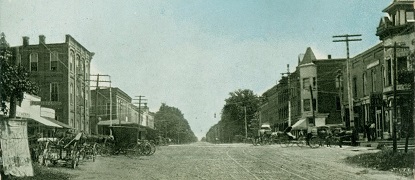
maiden name of his mother was given as "Mary Minor." Bronson's Chicago
Street, looking eastward
~ Son
William Henry Alderman Jr. ~ Son William Henry Alderman Jr. (1867-1940) was born on Feb. 4, 1867 (or in January 1967) in Indiana. He migrated to Bronson, Branch County, MI with his father, step-mother and siblings. At the age of 32, in
1898, Henry earned a living as a laborer. That year, he married 28-year-old
Katherine "Katie" Malova (1871-1932), also spelled "Malovey"
- "Malovy" - and "Molorey" in other source documents. A
native of Michigan, she was the daughter of Polish immigrants Stephen and Minnie (Kelly)
Malova, who had come to the United States in 1865. Their nuptials
were held on Nov. 15, 1898 in Coldwater, Branch County, MI, with justice of the
peace George M. White officiating, and with William Glen and Charles U. Champion
of Coldwater as witnesses. On their marriage license, Henry gave his mother's
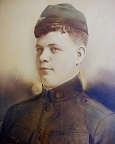
maiden name as "Mary Miner." Corp. Claud
Alderman in the Army They resided in
Bronson and had three children -- Claud William Alderman, Henry W. Alderman and Pearl
Patricia Kessler. When the federal
census was enumerated in 1900, the Aldermans made their home on North Mattison
Street in Bronson. Henry's occupation that year was day laborer. By 1910, when
the census again was taken, the family had moved to a new dwelling in Bronson on
Buchanan Street, with Henry working as a teamster in a wood yard. Tragedy rocked the
family during World War I, when their eldest son Claud joined the U.S. Army as a member of
Company A, 126th Infantry, 32nd Division. Over the winter of 1917, he trained at
Camp MacArthur, near Waco, TX and apparently played football with fellow
soldiers as evidenced by a photo of him in uniform. In February 1918, he and the
126th were shipped to Camp Merritt, NJ, and from there deployed overseas to
France. With the rank of corporal,
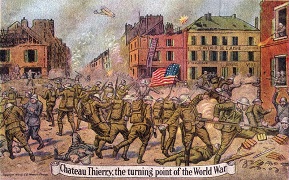
Claud was among 310,000 U.S. soldiers who took part in in the Battle of Chateau
Thierry, about 50 miles northeast of Paris. Tragically, he was killed in the
fighting of July 13, 1918, and his body was never recovered or identified. He
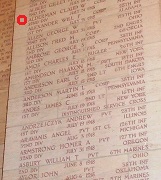
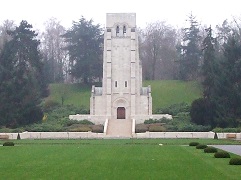
was memorialized at the chapel of the Aisne Marne Cemetery in France, in the
"Hall of the Missing," with his name etched among those of 1,060
fellow American missing at the battle, "who sleep in unknown graves."
In his hometown of Bronson, a memorial grave marker was placed in St. Mary's
Cemetery, although he is not buried there. As well, the local Veterans of
Foreign Wars Hall in Bronson was named after Claud and a fellow resident also
killed in the "Great War," bearing the name of the "Alderman-Luce
VFW Hall." Henry is believed to
have worked for H.A. Douglas Manufacturing Company in Bronson, and was a member
of the United Automobile, Aircraft and Agricultural Implement Workers of America
(UAW-CIO). He is mentioned in this connection in the proceedings of the
organization's ninth convention in 1944. Katie died in
Kalamazoo, Kalamazoo County, MI at the age of 60 on Aug. 5, 1931. Her remains
were returned to Bronson for interment. A marker was erected on her grave, and
the name of her son Claud (spelled "Claude") was etched into the
marker as well, although the whereabouts of his grave on the battlefields of
France is known but to God. Henry outlived his
wife by nine years. At the age of 73, living in Coldwater, Branch County, Henry
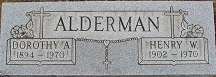
passed away on Christmas Eve 1940. He was laid to rest beside Katie in St. Mary's Cemetery in Bronson. Henry and
Dorothy's grave Son Henry W.
Alderman (1902-1970) was born in 1902. In 1930, at the age of 28, he lived with
his parents in Bronson and worked as a truck driver. Circa 1940, at age 38,
Henry was single and resided in the farmhouse of his 56-year-old divorced friend
Alva W. Blood in Matteson, Branch County, where he earned a living as a tool
maker. At some point in time, Henry married Dorothy A. (?) (1894-1970),
who was eight years his senior. They likely resided in or around Bronson, but
nothing more is known. Both Henry
and Dorothy died in 1970 and are interred together in St. Mary's Cemetery. Daughter Pearl
Patricia Alderman (1903- ? ) was born in 1903. At the age of 20, in 1923, she
was employed in Detroit as a telephone operator. There, she met and married a
co-worker, Ertman W. Kessler Jr. (1902- ? ). He was the son of Ertman W. and
Augusta (Brosofski) Kessler Sr. Their wedding was celebrated on Nov. 12, 1923 in
Detroit, led by justice of the peace Arthur E. Gordon, with Edgar J. Henris and
Charles Gordon of Detroit witnessing. They had one known son, William Kessler.
Pearl's granddaughter, Carol Bentley, graciously has provided valuable
information and images for this biography. Above, artist's
depiction of street fighting during the World War I Battle of Chateau
Thierry. Below, the "Hall of the Missing" with Claud's name (red
dot) in Aisne Marne, France.
~ Son
Simeon Miles Alderman - from the Second Marriage ~ Son Simeon Miles Alderman
(1872-1952)
was born on Dec. 12, 1872 in Indiana. He migrated to
Bronson, Branch County, MI with his parents and siblings. He was of medium
height and build, with black hair and black eyes. In the early 1890s, he
secured employment as a "railroad man." On June 20, 1893, the
20-year-old Simeon wed 16-year-old Michigan native Laura Canfield (1877- ? ),
daughter of C.F. and Comatta (Baird) Canfield. The event was held in Bronson,
with the ceremony led by justice of the peace F.A. Keyes, and their respective
fathers attending as witnesses. The Aldermans made
their home circa 1900 on Winona Street in Bronson. The census-taker noted that
they had been married for seven years, and that Laura had borne a child, but
that the child was no longer living. That year, Simeon worked as teamster, while
Laura's 16-year-old brother William M. Canfield lived under their roof and
earned income as a farm laborer. They remained on
Winona Street during the 1900s and in 1910 lived there, next door to Laura's
brother William who had since married and began having children. Simeon's
occupation in 1910 was as a day laborer, and Laura's aged grandmother,
72-year-old Canada-born Marriette Lilly resided in their home. As did his younger
brother Lewis, Simeon was required to register for the military draft during
World War I. At the time, he lived in Bronson and continued his occupation of
railroading for the New York Central Railroad. At the age of 79, in
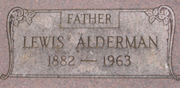
Sturgis, St. Joseph County, MI, Simeon passed away on Sept. 14, 1952. Lewis' grave,
Bronson, MI ~ Son
Lewis Almarian Alderman - from the Second Marriage ~ Son Lewis Almarian Alderman (1882-1963) was born
on April 25, 1882 in Michigan. He was at least twice
married, but the identity of his first wife is unknown. At the age of 18, in
1900, he lived at home and was employed as a laborer in a local cement works. In 1910, when the
federal census was taken, he lived in his parents' former home on Washington
Street ni Bronson and worked as a railroad section laborer. At the age of 33,
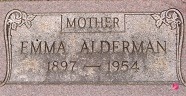
Lewis wed his second bride, 17-year-old Emma Dora Llewellyn (1897-1954), who was 15 years
younger, and the daughter of Ora and Florence (Prestidge) Llewellyn. The
ceremony took place on May 6, 1915 in Bronson. Rev. R.E. Saunders officiated. At the time of
marriage, Lewis was employed as a laborer. Emma's grave As World War I raged
in Europe, Lewis registered for the military draft in April 1918. At the time,
he and Emma lived in Sturgis, St. Joseph County, MI. There, he ran a drill press
for the Morency-Van Buren Manufacturing Company which produced plumbers'
supplies. The military draft registration agent noted that Lewis' "Thumb
& 1st finger off left hand." Lewis was a laborer in an automobile factory in 1920, when
the federal census was taken. He suffered the deaths of their daughter Wilma in 1940
and of his wife Emma in 1954. Lewis passed away in 1963. He is buried in
Bronson. For more information on this family, contact
great-great granddaughter Carol
Bentley.
The 8th Ohio Infantry made a mark of distinction at the Battle of Antietam on Sept. 17, 1862, where 22,726 men on both sides were killed, wounded or missing. It was the single bloodiest day on American soil, ever. In an astonishing twist, Henry was one of five members of the extended Miner family to be present that day. At the Bloody Lane/Sunken Road, his regiment fought alongside two others from two other states, among them the 132nd Pennsylvania Infantry (which included William Henry Miner and his brother-in-law Franklin Charles Wintermute) and the 7th West Virginia Infantry (including James Eyster Murdock Sr.).


Johns Hopkins University Press
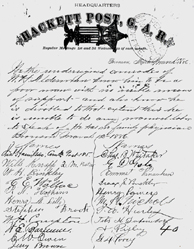
Statement about Henry's
healt
signed by members of his GAR post
Ohio
Infantry

He migrated to Bronson, Branch County, MI with his
father, step-mother and siblings.


Alderman Luce VFW in
Bronson
In 1930, a federal
census-taker recorded the family as living on Sherman Street in Bronson. Henry's
name is given as "Will" and son Henry, age 26, lived under their roof.
The 62-year-old father had no occupation, while the 26-year-old son was employed
as a truck driver.
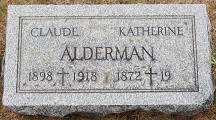
Katie's grave in Bronson, with
her son's name inscribed, although he rests in an unknown grave in France
He was 18 years younger than his eldest half-brother,
Franklin. As an adult, he was tall and slender, with blue eyes and brown
hair.
They
resided in Bronson, and had at least two children -- Howard Alderman and Wilma
Alderman (1919-1940).
| Copyright © 2005-2006, 2008, 2012, 2015, 2019 Mark A. Miner |
|
Bridge photograph by Nellie Dulovich |