
|
Rebecca
(Minerd)
Behme Kearns |
 |
|
Rebecca Behme Kearns |
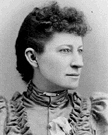
Rebecca (Minerd) Behme Kearns was born on June 24, 1850 near Tontogany, Wood County, OH, the youngest daughter of Samuel and Susanna (Hueston) Minerd.
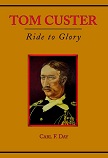
She produced a child out-of-wedlock with Thomas Ward Custer -- two-time Medal of Honor recipient for his Civil War bravery who later was tragically slain with his famous brother George at Little Big Horn. The relationship is discussed in the book by Carl F. Day entitled Tom Custer: Ride to Glory. It also was the theme of our 2002 national family reunion.
Their son was named Thomas C. Custer, Rebecca later married and produced a family of three more children.
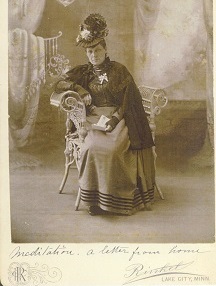 |
| Rebecca with a handwritten note, "Meditation, a letter from home." Rinkel, Lake City, MN |
The purpose of this webpage is to record Rebecca’s known life, through the best and highest quality documentation available. Our objective is to share information widely, invite input from diverse sources and ultimately to gain knowledge and broaden understanding of the past. Unfortunately, the full truth is not likely to be completely found.
Little is recorded of Rebecca’s early life, except that she grew up in Ohio near Tontogany. Her birth year is confirmed by the 1850 census, when she was enumerated as an infant in her parents' household.
Before Rebecca was born, her parents had resided near Scio, Harrison County, OH. Among the Minerds’ neighbors there in the 1830s and ‘40s was the family of Emanuel H. and Maria (Kirkpatrick) Custer and young children. Emanuel was the local justice of the peace who performed marriages, including at least one of Rebecca's cousins. Two of the Custers’ sons would go on to great fame in American military history -- General George Armstrong Custer (1839-1876) and Thomas Ward Custer (1845-1876), a highly decorated Union soldier in the Civil War. Both brothers -- along with three other family members, including brother Boston Custer, brother-in-law James Calhoun and nephew Harry Armstrong "Autie" Reed-- lost their lives in the Battle of Little Big Horn.
In fact, a statue of the general, seen here, stands on the site of the Custer birthplace memorial in New Rumley, OH. The statue is just a few hundred yards from several churches where our cousins are buried.
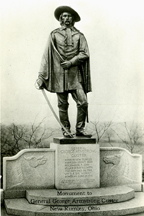 |
| The general's statue, New Rumley, Ohio |
Several booklets document Custer's growing-up years in Ohio, including a 1978 booklet, General Custer and New Rumley, Ohio, by John M. Carroll, and a 1993 booklet, Custer's Ohio Boyhood, by Charles B. Wallace. Much excellent published material is on file at the Puskarich Public Library in Cadiz, the seat of Harrison County.
The house where the Custer brothers were born now gone, but a memorial display stands in its place, near the statue, along Route 646 in New Rumley. Custer biographer Jeffry D. Wert has written that the brothers, who grew up there, "shared a bond of deep, abiding affection for each other." Best-selling author Stephen E. Ambrose devoted an entire chapter of his book Comrades to the Custers, saying that Tom "idolized his older brother in all things, ... most especially in risk taking."
~ Both Clans Move to Tontogany, Wood County, Ohio ~
In 1846, about five years before Rebecca Minerd was born, her parents left Harrison County and migrated to Wood County. They settled north of the town of Tontogany, in Washington Twp., in Section 29, Township 6, Range 10. They were enumerated there in the 1850 census, and today they are acknowledged as one of Wood County's "First Families."
As with the Minerds, the Custers also moved from Harrison County to Wood County. Tom's half brother David Kirkpatrick (1826- ? ) had been the first of the Custers to settle there. On Nov. 7, 1857, David married Nancy J. Gundy (1840- ? ) of Wood County, by the hand of Rev. Martin Perry. They put down roots, bought a 40-acre farm, and are shown in Washington Township in the federal censuses of 1860 and 1870.
In fact, he census-taker of 1860 recorded that the Kirkpatrick farm was just four dwellings away from the Samuel Minerd farm. David and Nancy had at least four children -- Emma Kirkpatrick (born 1860), John A. Kirkpatrick (1862), Thomas F. Kirkpatrick (1865) and Myron H. Kirkpatrick (1868). In 1876, David was named in Frederick Whittaker's book, A Complete Life of Gen. George A. Custer, which said he "lives in Wood County, Ohio, some forty miles south from Toledo." Nothing more about the Kirkpatricks is known.
The
Custer parents and remaining younger siblings came in April 1860, when Tom Custer was
about 15. Emanuel
Custer and his son Nevin J. Custer purchased a farm adjacent
to the Minerds' and thus were next door neighbors for many years. However, Tom Custer only lived on his parents' Tontogany
farm for less than two years, until his enlistment in the Army in September 1861.
|
|
|
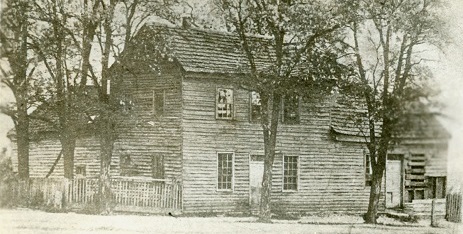
House in New Rumley were the Custer brothers were born |
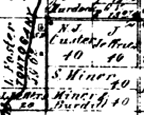 |
| 1871 Wood County atlas showing adjacent Custer and Miner farms |
Rebecca and the Custer children (Boston, Thomas and Maggie) would have known each other well and attended school together "in a little school house just north of Tontogany," said the Wood County Sentinel, taught by "Capt. L. Black."
An atlas map of Wood County published in 1871 shows the side by side Custer and Minerd farms, just east of Tontogany Creek. (The 40-acre farm marked "N.J. Custer" was owned by Nevin Custer; the farm marked "S. Miner" belonged to Samuel Minerd; and the 40-acre tract marked "Miner & Burdett" was co-owned by Samuel's son Jacob.) The primary Custer farm was south and west of the Minerd farm.
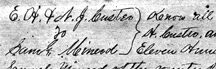 |
| 1867 deed when Emanual and
Nevin Custer sold a farm to Rebecca's father |
During the Civil War, Tom Custer served in the 21st Ohio Volunteer Infantry.
He distinguished himself for bravery, and was the first US soldier to win two medals of honor
-- for capturing enemy flags in two battles in Virginia in April 1865, at
Namozine
Church and Sailor’s Creek. During this action, while charging an enemy
position, he was wounded in the neck.
After the war’s end, Tom
continued serving in the Army with the 1st US Infantry and the 7th US Cavalry, primarily in
Kansas during the Indian Wars. The General wrote of their western experiences in
the book, My
Life on the Plains.
In 1867, Emanuel and Nevin Custer sold a 20-acre parcel of their farm to the Minerds, about the time that Emanuel was preparing to move to Michigan, to the town of Monroe. (A portion of the deed is seen here.) Nevin remained in Tontogany on his 40-acre farm for several more years, and was the last Custer to reside there. Tom Custer often visited his brother Nevin on this farm, and it was probably during these visits that Tom and Rebecca Minerd became acquainted.
~ More About Thomas Ward Custer ~
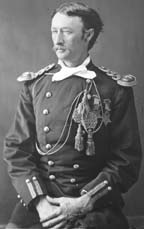 |
| Tom and his 2 medals of honor |
Famous, charming and sporting a battle scar, Tom never married, but was popular with young women. (He is seen at right, wearing his two Medals of Honor.) In the words of his famous sister in law, Elizabeth "Libbie" (Bacon) Custer, he “honored and liked women extremely.” She wrote this in her 1885 book, Boots and Saddles or Life in Dakota with General Custer. The book goes on to say:
 |
|
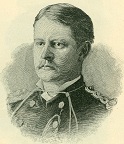
James C. Calhoun |
Colonel Tom used to pay visits of an unconscionable length to ladies of the garrison, and no amount of teasing on his brother's part would induce him to shorten them. [Tom] never knew, when he started to go home from these visits, but that he would find on the young lady’s door-mat his trunk, portmanteau, and satchel – this as a little hint from the general that he was overtaxing the lady’s patience.
A chronology of Tom’s life and military career is online, developed by nationally known Civil War expert Brian Pohanka along with Tom Custer biographer Carl Day. This excellent work shows that among other times, Tom was granted leaves of absence from December 1869 to March 1870; in February 1871; from January to May 1872; and from December 1872 to January 1873.
In 1876, father Tom accompanied his famous brother George, along with their brother Boston Custer, brother in law James Calhoun and nephew Harry Armstrong "Autie" Reed, into skirmishes and battles with Native Americans in the Black Hills of the Montana Territory. (Note -- James Calhoun, who was married to Tom's sister Margaret, commanded Troop L, and is seen at left.
~ Five Custers Die at Little Big Horn ~
Sitting Bull, the great leader of the Lakota people, swore a vengeance upon the Army, and General George in particular. The nations of Sioux, Lakota and Cheyenne warriors, led by Crazy Horse, finally clashed with Custer's troops with brutal finality on a windswept Montana battlefield.
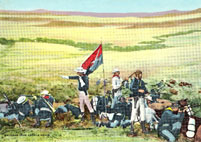
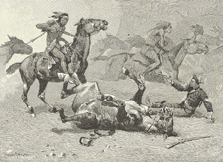
On June 25, 1876, at the infamous Battle of Little Big Horn, Tom, George and the other Custers were slaughtered, among more than 220 other members of the 7th US Cavalry. Tom's body was badly mutilated by the Indians as a sign of great disrespect. In fact, his remains were only later identified through a tattoo of his initials on his forearm. It was rumored that Sioux warrior Rain-in-the-Face, a sworn enemy of Tom's, cut out his heart and liver and ate them raw. The fact that five Custer family members were together at the end speaks volumes for their closeness as a family.
 |
|
Artists' renditions of the Battle of Little Big Horn |
The predominant legend is that Tom was disemboweled by his old nemesis Rain in the Face, as payback for being jailed by Tom some years before. In fact, the poet Henry Wadsworth Longfellow cemented this into popular culture in his poem, "The Revenge of Rain in the Face," although he took creative license by stating that the cut-out heart was the general's. An excerpt reads:
|
Excerpt
from |
|
The
sudden darkness of death
But
the foemen fled in the night, |
 |
|
Fort Leavenworth |
 |
|
Fort Leavenworth |
A military burial party placed the remains of the General and Tom in the same grave. "To protect the bodies from predators," says Nathaniel Philbruck's book The Last Stand, "the troopers placed the basked from an Indian travois over them and held it down with rocks. A yer later, a party led by General Sheridan's brother Michael traveled to the battlefield to retrieve the officers' bodies. They discovered that coyotes had managed to get at the grave of the Custer brothers and spread their bones across the grassy hill."
Less
than a month after the battle, the Perrysburg Journal in Wood County
disclosed that "Official reports received at the War Department in
Washington state that Gen. Custer's body was not mutilated in the least, but
that Capt. Tom Custer's heart was cut out and carried away."
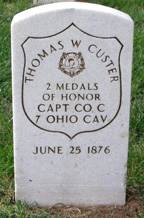
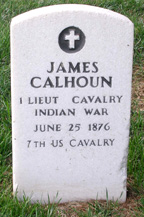
What little was left of the remains of Thomas and his brother in law, First
Lieutenant James Calhoun, were re-interred a little more than a year after the
massacre at Fort Leavenworth, KS. Their pomp- and- circumstance burial ceremony
was front-page news in the Sept. 8, 1877 edition of Frank Leslie's
Illustrated Newspaper.
Today Thomas and James rest in Section A, Graves 1488 and 148 respectively, of what is the Fort Leavenworth National Cemetery. The graves are among more than 23,000 other military veterans and their families who repose there for eternity, and are marked with standard-issue government military markers.
The General was buried in a grand ceremony at the United States Military Academy at West Point. The remains of the other two Custer family members lost at Little Big Horn -- brother Boston Custer and nephew Harry Armstrong "Autie" Reed -- were brought back to Michigan for interment at the Woodlawn Cemetery in Monroe.
Click to see a page of more family album photo images of the Custers.
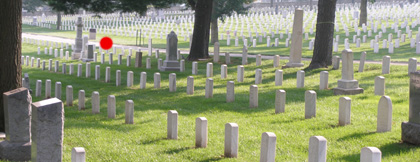 |
|
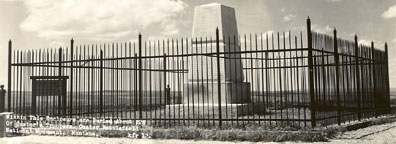
| Thomas and brother-in-law James Calhoun sleep in Fort Leavenworth National Cemetery where the red dot appears. Below: 1881 monument at Little Big Horn marks the mass burial site of slain non-officers. | |
|
|
~ Many Lingering Questions ~
 |
|
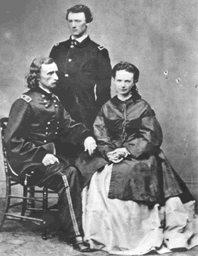
Tom with George and Libbie |
Many lingering questions about the Custer-Minerd story will forever be unanswered. How Rebecca Minerd, or her young son, reacted to the news of the Custers' slaughter likely will never be known.
In the years after the battle, General Custer's beautiful widow Elizabeth "Libbie" (Bacon) Custer worked diligently to preserve the memory of her dead hero-husband and the wayward brother-in-law she adored. A well-known carte de visite (CDV) photograph of the General, Libbie and Tom is seen here, taken by the Matthew Brady Studio in Washington, DC circa 1865.
One nagging thought is whether the Custers knew or acknowledged young Tommy as their own. Given the longtime friendship between the boy's grandfathers, and the proximity of their farms, one would suspect the Custers were -- at very least -- aware of the boy's existence. How would Emanuel Custer, who is known to have been very religious, had strong political ties, and realizing that his soldier-son was not going to take responsibility, have reacted to the possibility that the news might spread to the national press? Did he make a private arrangement with the Minerds to keep the issue out of the limelight? And then, after five members of Emanuel's family were slaughtered at Little Big Horn, what would have been his and his wife's emotional need to reach out and connect with young Tommy?
|
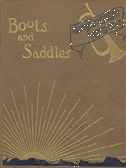
| Libbie Custer's bestseller |
Libbie was a frequent public speaker in the United States and Europe, drawing large crowds wherever she went. She also authored several best-selling books, including Following the Guidon and Boots and Saddles (seen here). Among other aspects, her popular memoirs bring out a little of the personality of Thomas, who otherwise is a shadowy figure in history.
In the 20th century, many films and made-for-TV movies were made about General Custer and the fatal battle. Of the four more popular efforts, only one -- the 1991 Sun of the Morning Star -- included an actor with speaking lines portraying Tom (Tim Ransom). The others, including the 1941 classic, They Died with Their Boots On (starring Errol Flynn as the General), the 1968 Custer of the West (starring Robert Shaw) and 1970's Little Big Man (starring Dustin Hoffman and featuring Richard Mulligan as Custer) did not include Tom as a character.
~ Rebecca's Life as a Wife and Mother ~
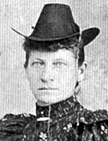 |
| Rebecca, date unknown |
Rebecca Minerd’s whereabouts during her son’s early life are unknown, but will be researched more thoroughly. The photo seen here shows Rebecca in a playful cowgirl-type hat, at an unknown date.
By 1876, she had married Nathaniel Arthur Behme (or "Beam") (1851-1914), a Tontogany resident, and the son of Julius H.D. and Mary Ann (Ketchum) Behme. The father was a German immigrant, and the mother a native of New York,
The Behmes went on to bear three children together -- Frederick Arthur Behme, Clara Kiggins Jensen Young and Samuel H. Behme.
When the federal census was taken in June 1880, Rebecca and Nathaniel resided near Tontogany with their three children Fred (age 4), Clara (3) and Samuel (2 months).
In 1890, records show that Rebecca and Nathaniel resided together in Bowling Green, Wood County.
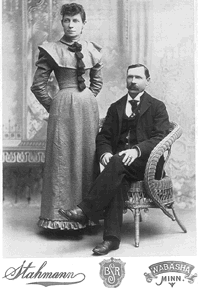 |
|
Rebecca and possibly Nathaniel |
During the decade of the 1890s, Rebecca and Nathaniel migrated north to Minnesota, settling near Minneapolis. Many family portraits of the Behmes were taken there. Later still, they moved directly south to Iowa.
Seen here is a photo of Rebecca with a man thought to be Nathaniel -- if so, the only known portrait of them together -- produced at the Stahmann Studio in Wabasha, MN. It is not dated, and his identity is not confirmed.
Heartache rocked the family in 1896, when Rebecca's son Tommy died in Tontogany. She was not with him at the time, and wrote later that she regretted that she had been unable to "come to see my dear boy when he was on his death bed." The guilt haunted her for the rest of her life.
In later years, when she was several thousand miles away on the West Coast, she wrote: "My heart aches to come home & see you all & my dear old father & the graves of my dear boy & my mother." Three years after Tommy's death, she wrote to her sister, asking for the address of Tommy's widow, saying "I want to write to her in regards to Tomie. I have something I want to ask her. Please do not forget it & write soon."
~ Rebecca's Letters Home ~
Over the years, as she lived farther and farther apart from her aging parents and siblings, Rebecca wrote letters home. They are articulate and filled with feeling. One can sense her longing to be with her relatives again, and the quiet desperation of knowing such a gathering was impossible. She signed her letters various ways, including "Beck" as well as "Re. Kearnes" and "B. Kearnes."
In one letter dated Nov. 18, 1907, Rebecca wrote: "We are as poor as ever. I don't ever look to be able to have a home any more but if I could only be able to come to see my old home once more I would be satisfied.... I can tell you this much it has only been poverty that kept me away from you folks but it takes money to travel. I could not come there & back for less than a hundred."
Rebecca
also complained about her own health. In an undated letter, she wrote: "I
am much healthier here. I had heart trouble so bad & here I do not have them
as often. I believe I should been dead long ago had I stayed back in Iowa."
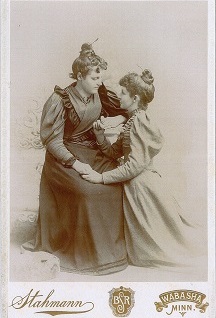 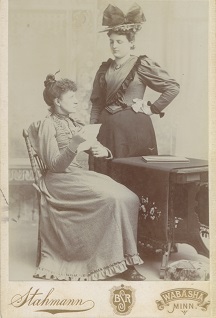 |
| Rebecca with unidentified young woman, possibly daughter Clara Stahmann, Wabasha, MN |
 |
|
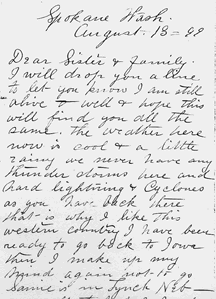
Rebecca's letter to her sister |
By about 1898, Rebecca and Nathaniel had separated. The marriage had been rocky, and in her own words:
[Son] Fred could not get much work & the old man did not try. I had a good place in a Tailor shop & made from 12 to 15 a week & he did not even try to get me wood. I had to by coal to roast his shins. His brother Jule told him he could have his team & all the wood if he would haul it & cut it but that was too hard work to go about nine miles to get it but it was not too much for me to wade in the snow up to my knees to work in the winter. It seemed as if the devil got in him... I think it is the same old devil in him his mother had.
Their children remained with Nathaniel in Iowa, while Rebecca made the decision to push further west to Washington State. Once she arrived on the West Coast, she sent a letter home, saying:
I do not know if we will go to Seattle to live or live here. Will decide when Clara gets here. We are getting beautifull weather here. The grass is nice & green & it is so warm. We have a nice country, no cyclones & very hard storms here which makes it so nice.
When the federal census was taken in 1900, Nathaniel was shown as making a home by himself in Iowa in Crystal Lake, Hancock County. The census-taker recorded him as age 51 and divorced, with his occupation as "day laborer." Sometime during the decade between 1900 and 1910, Nathaniel migrated to Washington, settling in Custer Township, Whatcom County. The 1910 census records him there employed as a farm laborer, and living next door to 64-year-old Antone Behme, possibly a brother.
At some point, whether in Iowa or in Washington, Rebecca married a man named Kearns. His first name is not known. At first the marriage was smooth -- she wrote to a sister about her new married life, saying:
...mine is not what it was in my young days. I don't have a man that comes home & curses me. He is too nice for that. He has never give me a cross word in his life & I think sometimes I am not thankfull enough... My husband thinks the world of [Clara] & is so good to her he don't want her to work out.
 |
|
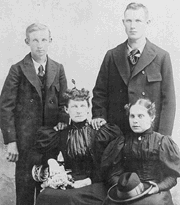
Rebecca with sons Sam (left) |
The marriage later turned -- in a letter from Port Townsend, WA, Rebecca wrote: "My husband never tells me his business if he has money or not I never know." In a letter to her sister, she confided:
I am going to tell you the truth which I never told you before (I think). I have not made any better choice than before, in some ways worse, for Clara's father would give me money when he had it. This one never gives me a cent, & I don't know what he does with it or if he has any. He never tells me his business. Sometimes I think he sends his money to some one I don't know of. He has not spoke to Clara since last March & she is a good girl as ever lived ... I wish I had stayed single.
The photo seen here shows Rebecca with sons Sam (left) and Fred and daughter Clara. It was taken by Chicago Photo Co. at an unknown date and location.
Moving frequently, Rebecca resided in Spokane, Spokane County (1899), Seattle and Port Townsend (1906), Everett (1907) and Blaine, Whatcom County (1914-1915). Whatcom is the most northwest county in Washington State, near the Canadian border. She once sent her sister some "fine ore" obtained at "the mines in British Columbia."
Rebecca earned income in Seattle through her sewing skills. In 1906-1910, they resided at 2307 North 63rd Street in the Green Lake section of Seattle. Though claiming to be "poor," she took out a $1,000 "Yeomen" life insurance policy for her daughter Clara, a $500 policy "in the Wood Craft" for her own burial, as well as a $1,000 policy "in the Maccabees" for her sons. It cost her $4.00 a month in premiums.
The federal census of 1910 shows Rebecca, daughter Clara Kiggins and son Samuel H. Behme living together on 63rd Street in Seattle. The census-taker spelled Rebecca's name as "Kearnes," marked that she was divorced and that she had borne four children, but that only three were still alive.
 |
|
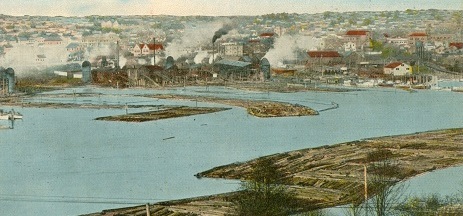
Bustling Seattle harbor, with timber headed to mills for processing |
~ Rebecca's Final Years in the "Wooly West" ~
In 1914 and 1915, Rebecca lived with daughter Clara in the Blaine/Custer area. Possibly contributing to a nagging misspelling of her first name, Rebecca was a member of the Custer branch of the Daughters of Rebekah Lodge in Seattle. The lodge was a women's affiliate of the Independent Order of Odd Fellows (IOOF), a men's organization. She was initiated into Lodge No. 156 in the Green Lake region of Seattle on July 11, 1911. While she did not hold any elective office with the group, she remained a member in good standing for the rest of her life and hosted
Rebecca and Clara hosted a Rebekah Auxiliary meeting at their home in April 1914 the day before Clara was to be married. The gossip columns of the Lynden (WA) Tribune reported that the the "evening passed pleasantly with conversation, luncheon being served about ten o'clock. A set of silver fruit knives was presented to Miss Behme...." Among the attendees were Mmes. Arndt, Bannister, Hale, Porter, F. Tarte, Marsh, Ed Jones, Ed Long, Otly, Parrish, Benedict, Brownell, Mundal, H. Brown and Claude Behme and Misses Bethen, Amy and Edna Behme.
In one letter home
to Ohio during that period, Rebecca wrote:
"Kiss my father
for me + tell him I said for you to do so + that I would work my nails off to
help to take care of him if I could only do so." Another time, she wrote:
"I
wish I was where I could do something to make his old days a little pleasant. I
would do all I could for him but here I am away out in this wooly west, many
thousand miles away…"
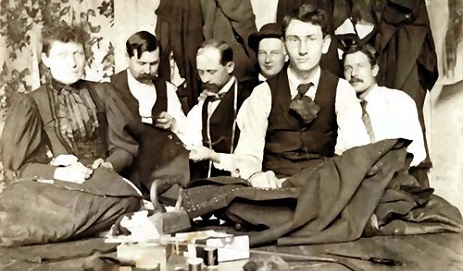 |
| Rebecca and others making dresses. Courtesy Judi Ockinga |
 |
|
Rebecca's final resting place |
Rebecca's ex-husband Nathaniel Behme also made his home in the Custer area. The Lynden Tribune noted in its Feb. 12, 1914 edition that he had received visits the previous Sunday from his son Fred and wife and Mr. Stoddard. His married daughter Clara Jensen came to see him on a Sunday in June 1914. Sadly, Nathaniel died on Sept. 4, 1914 at the age of 63. He was buried in the Enterprise Cemetery.
During that time, Rebecca suffered from cancer of the uterus, and the disease spread quickly to her bladder and bowels. She traveled to visit friends in Seattle in April 1914, but she became "quite ill with pneumonia," said the Tribune, and her health was on the decline. Upon returning home, her friends Mrs. R.M. Hale and Mrs. C.H. Bannister paid a call.
For her 64th birthday in June 1914, her daughter Clara Jensen hosted their Rebekah Auxiliary lodge in the Jensen home. "The afternoon was spent playing progressive pedro," said the Tribune. "The hostess served a delicious luncheon, at which Mrs. Marsh, in behalf of the Custer Rebekahs, presented Mrs. Kearnes with a cup, saucer and plate in remembrance of the day."
On Aug. 15, 1915, at the age of 64, she passed away in Blaine. She was laid to rest at the Enterprise Cemetery in Custer, WA, beside her first husband. Their red granite marker, still very legible, graciously was found and photographed in November 2005 by local Custer buff Phil Dyer.
|
|
|
Above, Rebecca and Nathaniel's grave marker, re-discovered in 2005, and cleaned by Custer history buff Phil Dyer of the Little Big Horn Associates, below. Note the star symbol at the top center of the marker, an early logo for the "Daughters of Rebekah" lodge. |
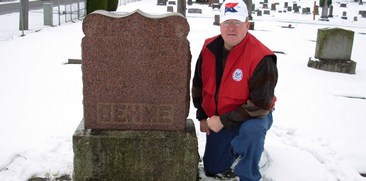
|
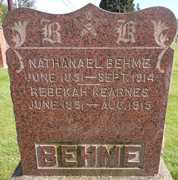
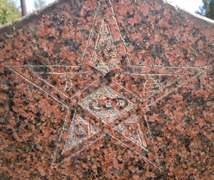
Daughter Clara must have only known a little of her grandparents back in Ohio, because on her mother's death certificate, she correctly named her Rebecca's father as "Samuel Minerd" but somehow mis-identified the maiden name of Rebecca's mother as "Van Austin." (It's possible she may have been confused with the name of her mother's cousin, Austin VanHorn.)
For more on the Behme family, see Matthew Aamot's webpages on RootsWeb.
 |
| Carl Day's book |
~ The Story of Rebecca and Tommy in Print ~
 |
|
Mark Miner's article |
Tom's story re-emerged to the public in 1990. That year, the August-September edition of the Timeline magazine of the Ohio Historical Society published Frank R. Levstik's article, "Our Brother Tom," which outlined his wartime heroics. An original copy is in our archives.
Carl Day's book Tom Custer: Ride to Glory was published in 2002 by Arthur H. Clark Publishing Co. of Spokane, WA. One reviewer has written that "Many years of research have gone into this book, so we can be certain that it's going to be an essential volume." It has generated additional public interest in the unusually close relationship between the Custers and our family.
On Oct. 25, 2003, cousin Beverly (Hansen) Miner and Minerd.com website founder Mark A. Miner led a tour of the Custer-Minerd homeplaces in Tontogany, Wood County, OH, as part of the Great Lakes Conference of the Little Big Horn Associates.
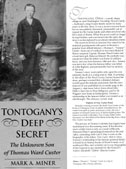
In 2005, the Research Review Magazine of the Little Big Horn Associates published an article, "Tontogany's Deep Secret: The Unknown Son of Thomas Ward Custer." Authored by Minerd.com founder Mark A. Miner, the 11-page article is illustrated with more than 20 rare photographs and images. It tells the story of Rebecca and Tommy, and how the community of Tontogany harbored the deep Custer family secret "which everyone knew but no one publicly discussed." In the preface, the magazine editor writes that the article reveals "documents, photos, newspaper articles and more in examining the only recently discovered evidence regarding Tom Custer's son... It presents an interesting insight into nineteenth century handling of illegitimate children."
 |
| Pittsburgh Tribune Review, 2011 |
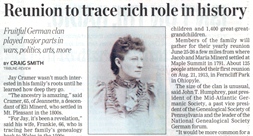
In a major feature article, "Reunion to Trace Minerd Family's Rich Role in History," published on June 13, 2011, the Pittsburgh Tribune-Review highlights our reunion and website, and prominently pictures Rebecca, telling her story.
Rebecca also was featured in an Oct. 3, 2011 article headlined "Whatcom County Linked to 'Deep Secret' About Lt. Col. George Custer's Brother," the Bellingham (WA) Herald. It tells the story of local man Phil Dyer's efforts to know more about her and her son, and his kindness in cleaning her moss-covered grave marker. The story includes a link to Rebecca's biography on Minerd.com and quotes from Mark A. Miner's award-winning article, "Tontogany's Deep Secret," published in 2005 by the Little Big Horn Associates.
Rebecca and her relationship with the Custers are discussed in a lavishly illustrated, 2011 book about one of her cousins who also served in the Civil War -- entitled Well At This Time: the Civil War Diaries and Army Convalescence Saga of Farmboy Ephraim Miner. The book, authored by the founder of this website, is seen at right. [More]
Another book about Tom which mentions his relationship with Rebecca is The Other Custers by Bill Yenne (Simon and Schuster, 2018).
Click to see another Minerd.com webpage featuring even more photo images of the Custers. For more information on the Custer brothers and the famed Montana battle at which they died, visit the website of the Little Big Horn Associates.
Further information on the Custer-Minerd connection is available through the Wood County (OH) Chapter of the Ohio Genealogical Society.
| Copyright © 2001-2012, 2016, 2019, 2023-2024 Mark A. Miner |
|
Portraitof Thomas W. Custer courtesy of the Denver Public Library. Portrait of George, Elizabeth and Thomas Custer courtesy of the Little Bighorn Battlefield National Monument/National Park Service. Book jacket courtesy of Arthur H. Clark Co. Pen and ink sketches of James Calhoun and the Battle of Little Big Horn published by The Century Magazine, January 1892. Rebecca Behme's grave photos courtesy of Phil Dyer. |