| Home |

|
Barbara
(Minerd) McKnight |
|
Old and new grave markers, spelled "Barbra" |
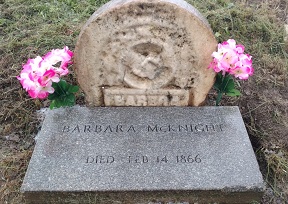
Barbara S. (Minerd) McKnight was born in about 1838 in or near Wharton Township, Fayette County, PA the daughter of Henry and Hester (Sisler) Minerd.
Details of her relatively short life are sketchy.
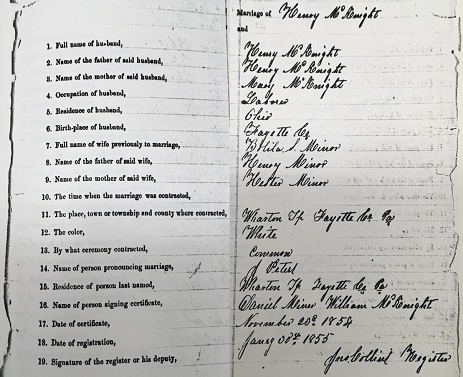
On Oct. 23, 1854, when she was age 16, Barbara was united in the bonds of holy wedlock with 26-year-old Henry "Foxy" McKnight (May 14, 1829-1915), the son of Henry and Mary (Washabaugh) McKnight.
The ceremony was held in her parents' home in Wharton Township, performed by J. Peters, also of the township. The wedding nuptials were witnessed by Barbara's brother, Daniel Minerd, and by her brother-in-law, William McKnight, husband of Mahala Minerd.
At the time of marriage, Henry was residing in Ohio and earned a living as a laborer. It's not known at what point he moved back to Fayette County and established their permanent home.
During their 11-plus years of marriage, the McKnights produced a family of five children -- Mary Hester Strauch, William McKnight, Ostman Theodore "Todd" McKnight, Charles McKnight and John Henry McKnight. Sadly, son William died in infancy in 1857.
Barbara and Henry lived at Uniontown and Dawson, Fayette County, where he worked as a coal miner and coke oven laborer. He stood 5 ft. 8½ inches tall, with a fair complexion, grey eyes and sandy-red hair.
|
Marriage license for Barbara and Henry, 1854, on file today in the Fayette County Courthouse in Uniontown, PA |
|
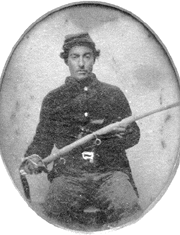
Civil War infantryman |
When the federal census was enumerated in 1860, Barbara and Henry, along with their young daughter and son, lived in Upper Middletown, in Menallen Township, near Uniontown. There, Henry worked as a day laborer, and was marked as unable to read or write.
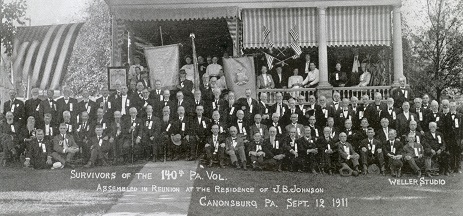
During the Civil War, on Aug. 25, 1862, Henry enlisted in the 140th Pennsylvania Volunteer Infantry, and was assigned to Company E. The photo seen here is thought, but not proven, to be him. Another distant cousin in our family was a member of the 140th Pennsylvania Infantry -- Cyrus Lindley, of Prosperity, Washington County, PA.
|
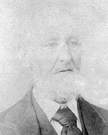
Henry in old age |
He is not known to have seen any action with his regiment during the 11 months he was with the Union Army.
While Henry and the 140th Pennsylvania were serving at White Hall Station, MD, on Dec. 1, 1862, he contracted an illness that kept him sidelined. In his own words, he "was thrown into a creek and caught a severe cold which brought on Rheumatism and Catarrh in [my] head."
He was treated at hospitals in York, PA from Dec. 1862 to May 1863 and in Pittsburgh until July 1863, when he received an early honorary discharge. He then returned home to his wife and young family.
Tragically, Barbara passed away shortly after his return from the war, on Valentine's Day, Feb. 14, 1866. She died from the effects of childbirth with her son John, and was only age 28. Her remains were laid to eternal sleep at the Cochran Cemetery at Dawson. A grave marker was erected at the burial site.
The widowed Henry was alone to worry about how to care for and raise his brood. He never remarried during his remaining 39 years of life. All evidence suggests that he remained close with his Minerd in-laws.
|
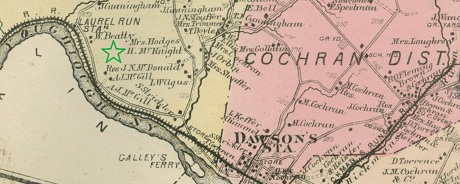
Above: 1872 Atlas of Fayette County shows the site of Henry's home (upper left, beside green star) near Strickler's Store and just north of the Youghiogheny River near Dawson, not far from Laurel Run Station. Below: Reunion of the 140th Pennsylvania Volunteer Infantry. Is Foxy in this image? |
 |
|
|
|
Henry with an unidentified woman |
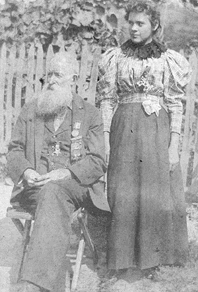
Their young, motherless son Charles was taken in by his uncle and aunt, Andrew and Mary (McKnight) Hiles of Dunbar, Fayette County. Another son, John Henry, was raised and adopted by Barbara's sister Mahala and her husband, William McKnight, who lived near New Salem, Fayette County. Who would have raised the other children is unknown.
Henry is seen here, wearing his Civil War medals and ribbons, with a young lady who is not yet identified but may be a granddaughter.
For the remaining 50 years of his life, Henry remained a widower. Despite constant arthritis ("rheumatism"), he continued to work in the coal and coke industry, and enjoyed attending Civil War reunions and encampments.
Henry is seen here as an elderly man, having lost much weight as he aged.
Henry worked with his son in law, John H. Strauch, and Strauch later observed: "I have worked with him in the mines from the winter of 1873 at intervals to the Spring of 1884...," claiming that Henry was not "able to work more than half the time, sometimes not for from 2 to 4 weeks at a time" due to his wartime disabilities.
|
Henry in old age |
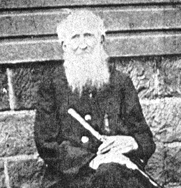
Justice of the peace William H. Cottom once wrote that "since 1865 [Henry] worked at the Fayette Coke works off an on for over five years and I was clerk and time keeper and I know that [Henry] was disabled from work fully one fourth of his time..."
In 1900, when the United States Census was taken, Henry dwelled under the roof of his married son and daughter-in-law, coal hauler Charles and Keziah (Stimmell) McKnight in Dawson. He continued to work during that time as a farm laborer.
Henry was close with his grandchildren, especially the Strauchs. Writing from an Army camp in Delaware in 1906, grandson Walter S. Strauch wrote:
Dear Grandady, I will take the pleasure of writing you a few lines to let you know that I have not forgot you yet... Say dady, I will send this picture to you. And you can see how I look since I was at home. I have got fatten up a little more now then when I was at home the last.
The federal census enumeration of 1910 shows the 80-year-old Henry making a home with his married granddaughter and her husband, Luzetta and Charles Cottom. Their next-door neighbors were Henry's son and daughter-in-law, Charles and Keziah McKnight.
|
|
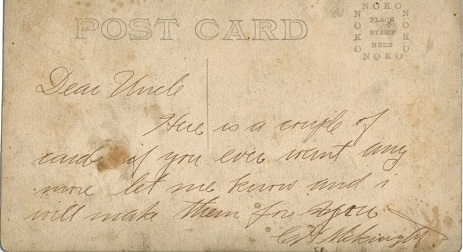
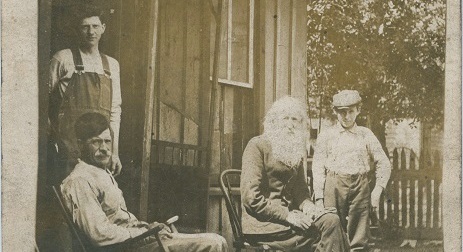
| Above: Henry in a 4-generation image with son Charles, grandson Clarence "Jay" and one of Jay's boys. Below: the handwritten back of the photo, reading "Dear uncle, Here is a couple of cards if you ever want any more let me know and i will make them for you. C.H. McKnight" Courtesy Debra (Minerd) Kemp |
 |
|
Henry's funeral card |
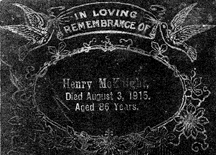
In 1912, Henry was mentioned by name in Robert Laird Stewart's book, History of the One Hundred and Fortieth Pennsylvania Volunteers.
Henry spent his final years in the Dawson area. Confined to bed for the last years of his life, with no use of his lower limbs, Henry died at one in the morning on Aug. 4, 1915. The cause of death, as written on his official Pennsylvania certificate of death, was "general arterial sclerosis." His daughter Mary Hester Strauch, also of Dawson, was the informant for the official Pennsylvania certificate of death.
His remains were placed into eternal repose beside his wife, rejoined in death after nearly a half century apart.
A portion of Henry's black, cardboard-backed funeral card, with faded lettering, is seen here.
|
Henry's old and new grave markers |

Their final resting place at Cochran Cemetery is near the grave of the burial grounds' namesake, Sarah B. (Moore) Cochran (1857-1936. She was the famed widow of coke industry baron Philip Galley Cochran, and as a wealthy widow was a generous philanthropist as well as board director of a number of banks and coal and coke companies as well as Allegheny College and American University. Her beautiful home, named Linden Hall, is now a famous Fayette County landmark and owned and operated as a conference center by the United Steelworkers of America.
In the 1960s or '70s, some of the McKnights' descendants -- believed to have been Charles Gibbons Sr. and Alberg Mong -- took the initiative to add newer- flat stones alongside their fading grave markers.
Details of the McKnights' marriage were published in the 1990s in the publication La Fayette: The History and Genealogy of Fayette County, in a section entitled "Marriage Records 1852-1855."
Henry also is mentioned in a lavishly illustrated, 2011 book about one of Barbara's cousin who also was a Civil War veteran -- entitled Well At This Time: the Civil War Diaries and Army Convalescence Saga of Farmboy Ephraim Miner. The book, authored by the founder of this website, is seen here. [More]
In July 2019, direct offspring Joseph Allen McKnight, assisted by his cousin Russell McKnight, with guidance from Corrine (Cremers) McKnight and a map drawn by Beth Lynne Radcliffe, cleaned the couple's original grave markers and placed them upright against the newer tablet stones. They also placed colorful flowers and took photographs of the installation.
| Copyright © 2000-2001, 2011-2012, 2019, 2023 Mark A. Miner |
| Grave marker photographs courtesy Joseph Allen McKnight |