| Home |

|
Jacob
M. Younkin |
|
|
|
Seven Pines Cemetery |
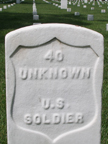
It seemed to be a typical Civil War tragedy. Jacob M. Younkin, a farmer boy from the mountains, got married and went off to fight for his country, and was killed in action. The government agreed to pay a pension to his grieving widow to compensate her for the devastating loss. In short, it was a cut-and-dried case, with all the facts in order, however sad.
Except for one key complication. Two women stepped forward after his death, each claiming to have been his wife, each having proof that they had been united in marriage with him in a ceremony performed by a minister of the gospel. This is the story of the effort to untangle the matrimonial mess, involving "Widow Sarah" Younkin and "Widow Mary Jane" Younkin, one of them legitimate, the other bogus.
The soldier, Jacob M. Younkin, was born on a farm near Kingwood, Somerset County, PA, in about 1840, the son of John M. and Laura (Minerd) Younkin. It is not known if he attended school, or what he did for fun, though he probably stayed close to home. It was later stated that he had "lived in what is known as the Mountain, and was probably never in Uniontown twice in his life" before the war.
In about 1860, Jacob moved to nearby Normalville, Fayette County, PA. A year later, when the Civil War had been underway only a few months, he left home to enlist in the 85th Pennsylvania Volunteer Infantry. He was mustered into the regiment on Nov. 7, 1861 at Uniontown. The 85th trained there at Camp Fayette for a short time before marching toward the battle lines in Virginia.
|
|
|
The Battle of Fair Oaks -- from an old Currier & Ives print |
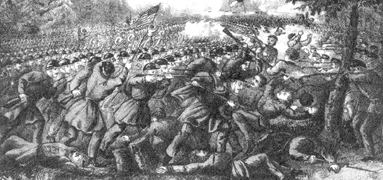
Among the regiment's early activities were siege operations in front of Yorktown and an engagement near Williamsburg. In May 1862, the regiment marched to Fair Oaks Station and began to fortify the area. The men were busy constructing a redoubt on May 31 when the enemy attacked. The 85th took a position in rifle pits on the right side of the main work.
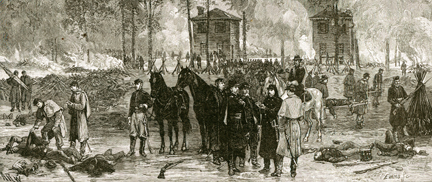
During seven days of extended fighting, Union and Confederate losses totaled 11,000 men. The 85th Pennsylvania Infantry itself had 87 casualties. One of the dead was Jacob M. Younkin. How he was killed is unknown.
|
|
|
Burial of soldiers and burning of dead horses after the Battle of Fair Oaks Station. The Century Magazine, May 1885. |
|
|
|
Seven Pines Cemetery. Harper's Weekly |
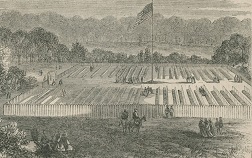
Jacob's final resting place is not known precisely. Soldiers killed at the Battle of Fair Oaks/Seven Pines were quickly interred at the Richmond National Cemetery and the Seven Pines National Cemetery, which together contain the graves of approximately 6,950 unidentified soldiers. Most likely he is one of these unknowns.
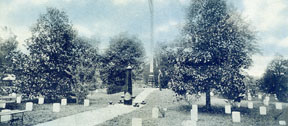
A rare old photographic postcard, seen at left, shows the Seven Pines Cemetery as it looked circa 1907, when the card was postmarked.
The news of the battle, and of Jacob's demise, quickly reached home. His name was printed in a casualty list in the June 12, 1862 edition of the Uniontown Genius of Liberty, along with the names of William Howard and John Riley.
On Oct. 1, 1862, four months after Jacob's death, 26-year-old Sarah Floyd (Miller) Younkin ("Widow Sarah") appeared before a Fayette County court official. She said she was the widow of Jacob Younkin of the 85th PA Infantry. As per the provisions of a recent Act of Congress, she claimed to be entitled to a widow's pension. She had documents to prove she was married to the soldier in Uniontown on Nov. 16, 1861, shortly before the regiment left town, but that she had produced no offspring. Her friends Amanda Miller and Ann Floyd swore oaths confirming her claims.
Jacob named in the Uniontown
The
paperwork was in order. On April 4,
1863, the government approved Widow Sarah's pension, at a rate of $8 a month, retroactive to May 31, 1862, the date the soldier died.
She thus received a windfall of a year's worth of payments.
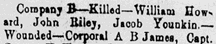
Genius of Liberty,
June 12, 1862
The monthly checks suddenly stopped five months later. Something, or someone, was amiss. It turned out that officials had discovered something that Widow Sarah may never have been told -- that her husband was also married to a woman named Mary Jane ("Widow Mary Jane") and had a young son named J. Harvey Younkin living back home in the mountain.
Confusion ensued. Investigations were launched. The dust did not settle for years.
|
|
|
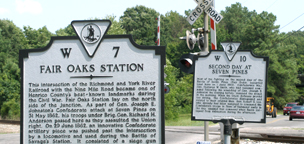
Battle area markers displayed circa 2006 |
Documents and witnesses were furnished to show that the soldier actually had wed a double cousin, Mary Jane Christner (1841- ? ), the daughter of Levi and Catherine (Younkin) Christner of Springfield Township, Fayette County.
The marriage between Jacob and Mary Jane took place near Kingwood on June 26, 1859, about two years before the war began. Soonafter, the couple moved to near Normalville and "lived together as man and wife, and were so reputed in the Neighborhood," wrote one observer. Witnesses testified about the birth of the couple's one and only child, Harvey, in July 1860. Although Widow Mary Jane had since remarried, to one Daniel K. Grim, and died within a few years, her son Harvey had a legitimate claim to his late father's pension.
 |
|
Seven Pines Cemetery, Virginia |
Harvey's guardian, postmaster John W. Sherbondy of Normalville, wrote a rather blunt summary:
Jacob Younkin was in camp at Uniontown twenty odd miles from home. He is reputed to have married Sarah Floyd of Uniontown, at which place was located Camp Fayette, the Rendevouz of said Regt, and just four days before the Regt marched to the front. This Sarah Floyd was a reputed [prostitute], taking all the circumstances. I am satisfied that Younkin was drunk when he married this Sarah Floyd, who was well known as a [prostitute], and that he did not care, as he would not then be detected as the Regt was then under marching orders. The witnesses who testified that he left no child surviving him, could only have known him while in camp at Uniontown....
With all the new facts in hand, the government recognized Widow Mary Jane as the soldier's true wife, and it granted young Harvey Younkin's pension in August 1869, more than seven years after his father's death. It is doubtful that Harvey even remembered his father. Under the terms, the payments were retroactive to the date of death, and thus Harvey would have received a lump sum of about $688 in back payments, a huge amount at the time. He then was to receive monthly payments of $8 until his 16th birthday, to occur in July 1876.
How Widow Sarah reacted, or whether she ever refunded the money erroneously paid to her, remains a mystery.
~ The Rest of Widow Mary Jane's Story ~
|
|
|
Mt. Zion Cemetery |
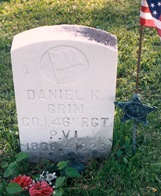
After Jacob's death, Mary Jane did not remain single for long. Just six months later, according to research by the late Donna (Younkin) Logan, Mary Jane wed Daniel K. Grim (1836-1923), on Nov. 23, 1862. Grim was a longtime resident of Springfield Township, and was five years older than she.
Mary Jane and Daniel had at least five more children of their own -- Phoebe Ann Grim, Ellen Grim, George Grim, Henry Grim and Lucy Grim.
During the Civil War, Daniel was drafted into the army, and enlisted on Sept. 16, 1863. He served as a private in the 46th Pennsylvania Volunteer Infantry, Company I. According to military history records, the regiment served as guards along the Nashville & Chattanooga Railroad between Chattanooga and Bridgeport. He deserted on Nov. 19, 1864; returned to the regiment on May 10, 1865, after the war's end; and was discharged the following day, on May 11, 1865.
Following Daniel's return from military service, the Grims moved into the city of Connellsville, Fayette County, where Daniel secure employment as a "domestic servant." They are enumerated there, in the federal census of 1870. The census-taker recorded that neither husband or wife could write.
Son J. Harvey Younkin lived for in the Grim household for about seven years. At the age of nine, he went to live in the Uniontown Soldiers Orphans School at Jumonville, near Uniontown. He remained there for seven more years, from Sept. 14, 1869, to about mid-June 1876, when he reached the age of 16 and was graduated.
Sadly, Mary Jane passed away during the 1870s, after the birth of daughter Lucy in 1873, and before the federal census was taken again in 1880. The details are not known, but are being researched.
As a widower, Henry obtained work as a coke oven laborer in Upper Tyrone, near Dawson, Fayette County. He and children Henry and Lucy lived together in 1880, as shown in the census. He also drew a federal pension for his military service during the war. (App. #663/336, Cert. #492.579)
In 1900, Daniel made his home near Vanderbilt, Fayette County, and at the age of 64 was marked as "widowed" and had no employment. Living under his roof that year was his 57-year-old "aunt," Lyda J. Keffer (1843- ? ), also widowed, and the mother of 10 children, of whom four were alive at that time.
Daniel and Lyda (or "Lida") continued to co-habitate for at least a decade more. In 1910, their home was on the west side of Main Street in Vanderbilt. One of Lyda's sons, 34-year-old widowed John W. Keffer, lived under their roof, and was a local coal mine laborer. Daniel's whereabouts in 1920 are unknown.
He died in 1923, at the age of 87, and was buried in Mt. Zion Cemetery in Saltlick Township, Fayette County.
Daughter Ellen Grim (1864- ? ) was born in 1864 while her father was away serving in the Civil War.
Son Henry Grim (1867- ? ) was born in 1867. In 1880, when he was age 13, a census-taker recorded that Henry could not read or write, and was "maimed, crippled, bedridden or otherwise disabled." The nature of his infirmity is not yet known.
Daughter Lucy Grim (1873- ? ) was born in 1873. Her fate is lost to history.
Click here for more information on the many "Kissin' Cousin" marriages between the Minerd and Younkin families of the 19th century. This biography is adapted from the article, "The Soldier Who Had Two Widows" in the July 1993 edition of the Younkin Family News Bulletin.
|
Copyright © 1993, 2000, 2002, 2004-2007, 2010, 2012 Mark A. Miner |