
|
The National Road |
|
Honoring Cousins of the 1800s Who Lived and Labored Along Our Country's First Super Highway, the National Turnpike, Today Known as "U.S. Route 40" |
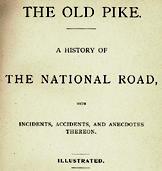
 The National
Turnpike, also known as the National Road and the National Highway, was our
nation's first super highway, and provided employment and/or a convenient home
location for a number of Minerd-Minard-Miner-Minor cousins from Pennsylvania to Indiana.
Before the advent of the Interstate Highway System following World War II, it
was "the only highway of its kind ever wholly constructed by the government
of the United States," wrote Thomas B. Searight in his 1894 book, The
Old Pike: A History of the National Road.
The National
Turnpike, also known as the National Road and the National Highway, was our
nation's first super highway, and provided employment and/or a convenient home
location for a number of Minerd-Minard-Miner-Minor cousins from Pennsylvania to Indiana.
Before the advent of the Interstate Highway System following World War II, it
was "the only highway of its kind ever wholly constructed by the government
of the United States," wrote Thomas B. Searight in his 1894 book, The
Old Pike: A History of the National Road.
The highway was the brain child of political heavyweights Albert Gallatin and Henry Clay, and was passed into law by vote of Congress and the signature of President Thomas Jefferson. "From the time it was thrown open to the public, in the year 1818, until the coming of railroads west of the Allegheny mountains, in 1852, the National Road was the one great highway over which passed the bulk of trade and travel, and the mails between the East and the West," Searight wrote. "Many of the most illustrious statesmen and heroes of the early period of our national existence passed over the National Road from their homes to the capital and back, at the opening and closing of the sessions of Congress..., [becoming] familiar figures in the eyes of the dwellers by the roadside."
Among the national celebrities and their contemporaries who rode the Pike were Presidents William Henry Harrison, John Quincy Adams (May 1837), James K. Polk, Andrew Jackson and Zachary Taylor in addition to Gen. Marquis de Lafayette, Senator Henry Clay (May 16, 1844), Tom Corwin, Gen. Sam Houston, James G. Blaine, circus man P.T. Barnum, singer Jenny Lind, J.W. Crittenden, Shelby, Allen, Gen. Scott, Gen. Butler and the eccentric Davy Crockett.
 |
|
The "Conestoga Wagon" by Malcolm Parcell. The caption reads: "Completing the National Pike across the Allegheny Mountains gave birth to the Conestoga Wagon, drawn by six horses and manned by 'Pike Boys.' Between 1819 and the early 1850's a constant stream of these picturesque wagons were used over the Pike to and from Baltimore in transporting merchandise, supplies, and produce." |
  |
|
Old National Pike stagecoach and Conestoga wagon depicted in the book Stories of Pennsylvania by Joseph S. Walton, PhD and Martin G. Brumbaugh, AM, PhD (New York-Cincinnati-Chicago: American Book Company, 1897). |
 |
|
The Good Intent line operated on the Pike before the Civil War, known for high speeds and aggressive competition and for transporting not only travelers but also postal mail and perishable foods such as oysters from the East Coast to the midwest. One of its more popular stops was the Mount Washington Tavern near Uniontown, serving travelers with quick family-style meals and refreshing horses. From Stories of Pennsylvania by Walton and Brumbaugh. |
 |
|
National Road near Uniontown, PA |
Several cousins, including Perry G. White and his son Robert Marshall White were construction contractors on the highway in Somerset and Fayette Counties, PA, as early as 1843. Perry is named twice in Searight's 1894 book, and among a long list of men who were "contractors for work on the original construction of the road." During the period from May 1, 1843 to Dec. 31, 1844, Perry is known to have worked on the Western Division of the National Road under the supervision of William Searight, Commissioner of the Cumberland Road in Pennsylvania, and was paid $116.06 for his labors.
Later, said the Uniontown Republican Standard, "When the late Sebastian Rush was first appointed superintendent of the National road, about twenty-five years since, he put [Perry] in charge of the Monroe gate and he continued to hold such ever since up to the time of his death." Perry's work provided him with "general satisfaction," said the Uniontown Genius of Liberty.
 |
|
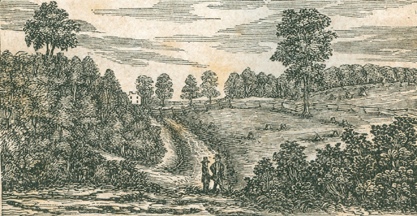
Rare sketch of Braddock's Grave, early 1840s, |
William Alexander Gaither and his family resided along the highway near Chalk Hill, Fayette County, where in 1877 he was appointed as a reviewer of National Road spur construction plans in Wharton Township. In about 1871, Gaither also was named a caretaker of one of the road's most famous landmarks, the ancient grave of British General Edward Braddock, who was mortally wounded in battle during the French and Indian War. A rare sketch of the site, drawn in the early 1840s, is seen here. According to the artist who sketched this view, "A plain shingle, marked BRADDOCK'S GRAVE, nailed to the tree where part of the bones are interred, is the only monument to point out to the traveller the resting place of the proud and brave but unfortunate hero of the old French war."
Among those cousins who also lived along the National Road in Fayette County were Joseph and Sarah "Annie" (White) Hopwood in Hopwood, and Eli and Catherine (Dean) Leonard in Wharton Township. Franklin Ellis's 1882 book, History of Fayette County, states: "The Old Braddock road entered Wharton [Township] from Henry Clay [Township], on the farm now owned by McCarion, then by Eli Leonard's to the Widow Dean's, back of Farmington..." Further west, in Washington County, PA, Lynn and Grace (Miner) White made their residence along the road, then known as Route 40.
| ~ Malcolm Parcell Paintings ~ |
 

|
|
"Escape of David Bradford." The caption: "David Bradford leader of the Whiskey Insurrection of 1794, resided in the old stone house still standing at 173 South Main Street, Washington. When the Insurrection collapsed Bradford fled to the Spanish province of Louisiana; and tradition says that he escaped on horseback shortly before troops arrived with orders to place him under arrest." |
 |
|
"Stage Coach." Caption: "Rapid transportation of travelers over the National Pike a hundred years ago was by stage coaches drawn by from four to six and sometimes eight horses. With its load of passengers and mail, it always created a flutter of excitement as it sped along the Pike at top speed. Horses were changed at relay stations twelve miles apart." |
 |
|
"Interior of a Tavern in Old Washington Town." Caption: "A typical tavern scene of the olden times of the National Pike, when the barroom was the village meeting place for travelers, stage drivers, wagoners and town loafers." |
 |
|
"Lafayette's Visit, May 25, 1825." Caption: "The most important visitor in old Washington during the days of the National Pike was General lafayette, who arrived here May 25, 1825, while on a tour of the United States as the nation's guest, and stopped over night at the Globe Inn. Fully 15,000 people from all sections of the country lined the street to greet him." |


|
|
"Pony Express and the Packhorse." Caption: "The original Pony Express was conceived in 1835 by Postmaster General Amos Kendall to speed delivery of light mail. Horses were changed every six miles. The Packhorse was the only means of transportation when old mud trails were impassable for the heavy Conestoga Wagon. The well with its windlass and 'Old Oaken Bucket' was found at every tavern along the length of the National Pike." |
 |
|
"The Arrival of Henry Clay, May 16, 1844." Caption: "Henry Clay, the 'Father of the National Pike' and one of the most noted statesmen of his time, was a frequent and welcome visitor in Washington while traveling between his Kentucky home and the National Capital. This shows Mr. Clay arriving at the famous Globe Inn on May 16, 1844." |
 |
|
Black Eagle Inn, between the towns of Addison and Somerfield in Somerset County, PA, a prominent Pike stagecoach stop and tavern. Stories of Pennsylvania by Joseph S. Walton, PhD and Martin G. Brumbaugh, AM, PhD (New York-Cincinnati-Chicago: American Book Company, 1897). |
~ National Road in Ohio ~
Some of our cousins lived along or near Route 40 in Brownsville, Licking County. Among them were Jacob and Mary (Ferguson) Miner, and their son James S. and Angeline (Hamilton) Minor, who resided a block from the National Road in Brownsville circa 1866. Jacob and Mary's son, Civil War veteran Daniel L. and Frances (Vreeland) Minor, lived directly beside the road in 1877, just about a block west of town.
 |
|
Atlas maps of Brownsville, Ohio. Above, from 1866, right after the close of the Civil War. The residences of Jacob and son James are marked with red dots, along Fifth Street at the northwest corner of the town's boundary. Below, the 1875 map, with Daniel's home marked with a dot, west of town. |
|
|

 |
| Riley home in Greenfield, IN |
|
|
|
James W. Riley |

~ National Road in Indiana ~
In Indiana, in the town of Greenfield, Hancock County, John and Mary (Bush) Anderson owned a house on 106 East Main Street (Route 40).
One of the Andersons' neighbors several blocks away on Route 40 was a famous American writer, James Whitcomb Riley, the "Hoosier Poet," said to have been "one of the best known Hoosiers of all time ... [and] famous for his use of Hoosier dialect." He was the author of such works as "The Old Swimmin' Hole" and "Mongst the Hills of Somerset."
Benjamin S. Johnson, husband of Allora Bush, also of Greenfield, considered Riley his best childhood chum.
Riley, whose house is seen here, was a master at capturing the Indiana country dialect and turning it into lyrical poetry. Ironically, upon traveling in the east and visiting Somerset County, PA, he wrote these lines:
|
'Mongst the hills o' Somerset |
|
~ The National Road in Pennsylvania, West Virginia, Ohio and Beyond ~ |

|
| An "address to Old Hickory" -- in Ben Bean's ("Barton") house - Harpers New Monthly, Nov. 1879 |

|
| Arrival of the coach at an old stage station - Harpers New Monthly, Nov. 1879 |

|
| Old government toll-gate, with west-bound express - Harpers New Monthly, Nov. 1879 |

|
| Ruins of old post tavern - Harpers New Monthly, Nov. 1879 |

|
| Old National Pike bridge - Harpers New Monthly, Nov. 1879 |

|
| Old way-side tavern - Harpers New Monthly, Nov. 1879 |

|
| An old smithy - Harpers New Monthly, Nov. 1879 |
|
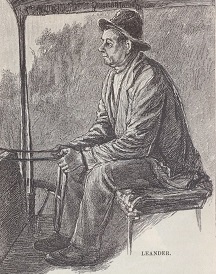
| Old stagecoach operator and driver - Harpers New Monthly, Nov. 1879 |
|
|
|
Above: 1876 Atlas of Somerset County, PA, showing the toll house in the community of Petersburg, today known as Addison. |
 |
| The famed "Old Stone House" a.k.a. "Fayette Springs Hotel" |
|
|
| Picnic park at the National Road summit near Uniontown, PA |
|
|
| Big Watering Trough Restaurant fives miles east of Uniontown |
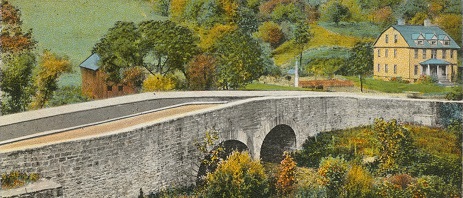 |
| Famed "S" curve stone bridge over Buffalo Creek in Claysville, PA |
|
|
|
The National Road between Washington, PA and Wheeling, WV |
|
|
| A relatively flat stretch near Wheeling, WV, 1940s |
|
|
| Motorists between Wheeling, WV and St. Clairsville, OH |
| Copyright © 2006-2010, 2013-2015, 2018, 2023, 2026 Mark A. Miner |
|
Malcolm Parcell mural paintings originally published by The Pioneer Grille, George Washington Hotel, Washington, PA. |


