| Home |

|
William
Allen 'Will' Miner |
|
Will and Osta Miner |
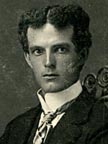
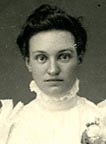
William Allen "Will" Miner was born on April 13, 1876 near Nineveh, Greene County, PA, the son of Andrew Jackson and Mary Louise (Johnston) Miner. Will was a "character"' and over the years his work as a Methodist preacher and family history buff influenced many people.
As a boy, Will lived near Waynesburg, PA; Hundred, Wetzel County, WV; and Chartiers Township near Canonsburg, Washington County, PA. By 1900, he was residing in the home of his cousin, Elizabeth (Miner) Lindley in Washington, PA and was working as a laborer in the local tin mill, and as a packer in a glass house.
A literate and well-read man, Will received in 1888 a book entitled Little Jackie as a gift from his friend Maggie Smith. It remained in his possession until his death nearly seven decades later. When his grandmother Elizabeth (Owen) Johnston died in 1899, he was asked by his great-uncle Stephen W. Johnston to serve as executor of the estate.
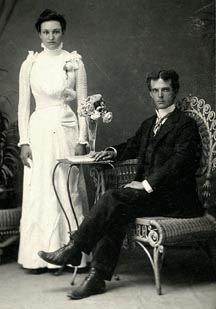
On July 3, 1900, at the age of 23, Will traveled to Cambridge, Guernsey County, OH to marry his childhood friend and sweetheart, Osta Arminta Cain (1880-1946), the daughter of James C. and Margaret Ellen (White) Cain of Hundred, Wetzel County, WV. A copy of their marriage license is on file today in the county courthouse. The Miner and Cain families were close, and Osta's sister Armena married Will's brother Harry.
The newlyweds first lived in Washington, and they are known to have visited his parents in Canonsburg in September 1900. Not long afterward, Will's father bought a small house on Broad Street in Washington and made a move there. They joined the West Washington Methodist Episcopal Church.
|
|
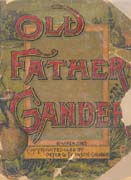
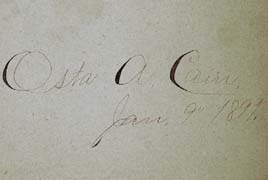
Old Father Gander book that Osta received and inscribed on Jan. 9, 1891, when she would have been age 11, and kept in the family for years. |
|
Will and his library. Enlarge |
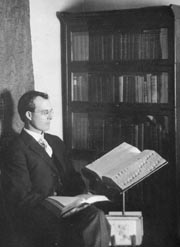
Sadly, a year later, in 1901, Will and Osta's unnamed infant son died in Washington. The baby boy was buried at Washington Cemetery. Osta never was able to bear children after that.
Over the years, Will worked off and on as a preacher but primarily made his income as a carpenter and building contractor. He was very literate and once was photographed reading what appears to be a Bible and a dictionary in his home study. The image could well have been taken by his brother Ward, who was a professional photographer. (A larger version of this image was our "Photo of the Month" in February 2004.)
In 1905, the Miners traveled to Denver to visit Will's brother Ward and to attend the Epworth League Convention of the Methodist Church. They moved to Denver circa 1906 and stayed a few months before migrating onward to Los Angeles. He wrote a letter to his parents, published in the Washington Reporter on Nov. 1, 1906, which said that "spring crops are being planted and other spring work is being done. Roasting ears are almost constantly in the market and green lima beans may be purchased. No rain has fallen since last spring, but Mr. Miner says crops are looking well, all owing to irrigation. He went to California for the purpose of engaging at the carpenter trade, and in less than a week was awarded the contract for the erection of a costly residence. Wages, he reports, are good, a good workman having no trouble in getting $4 a day. Mr. Miner and family are well pleased with the country especially the climatic conditions."
Will served a number of small congregations in the states of Mississippi, Colorado, Virginia and Pennsylvania. He kept a small journal detailing his moves, expenses and income, and lists of church members. He accepted his first known ministry position in 1909, in the town of Meriden, MS, though he later claimed that an outbreak of malaria in the community forced him to change his plans and leave town.
|
Journal of Will's pastoral assignments |
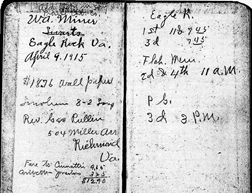
Two years later, in 1911, Will and Osta relocated to Colorado so that he could cover pastorships from three churches -- Wright's Memorial, Yuma and Otis. They remained in the circuit until March 1912, with Will preaching 30 times and earning a total salary of $162.70.
Also making their home in the Denver area during this time were Will's brother Ward, who was suffering from a fatal case of tuberculosis, and two of Will's uncles, Benjamin "Addison" Johnston and Cassius Marcellus "Clay" Johnston, as well as several households of Johnston cousins.
In 1913, evidence exists that Will graduated from Taylor College in Upland, IN, a Christ-centered college in the Methodist tradition. The pair then returned to Western Pennsylvania, with him assigned as a preacher in the "Swarts Circuit" near Waynesburg, PA. (The Swarts United Methodist Church stands today.) He made news when preaching morning and event services in his home church in July 1913, in what the Washington Reporter called "two very excellent sermons... He was very active in the Ostrum evangelistic services held here four or five years ago, and as a result of that campaign decided that he would take up the ministry. He sold his property in the Eighth ward and with his wife went to Meriden Miss., but on account of malaria there he went to Taylor..."
After a few months, they left and by Christmas 1913 were back in Southern California, in the town of Pomona. He sent his mother several postcards, and in reply she sent him a penny postcard, describing her health problems, church activities and the price of food. Her card is preserved today in the Minerd.com Archives.
In 1915, Will accepted a three-church position at Eagle Rock, Piney Grove and Flaherty Memorial, VA. He was paid partly in ham, butter, potatoes, eggs, berries, chicken, meat, apples and beets, along with a cash salary of $472. Later, they moved back to Denver. In 1919 they returned to Washington, PA, and shortly thereafter moved again to California. The story in the family is that he abandoned the ministry as he did not have the stomach or temperament for the more difficult aspects of the work.
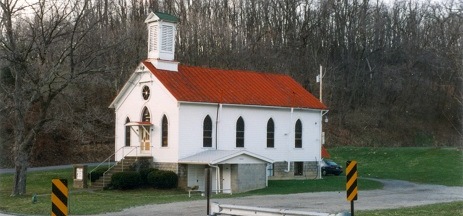 |
Swarts United Methodist Church, Greene County, PA, 1994 |
|
Wedding portrait |
Will registered for the military draft during World War I, and listed his occupation as a self-employed carpenter, residing at 260 Fayette Street, Washington.
Tragedy struck in the summer of 1919 when Will's brother Harry suffered two strokes, the second of which was fatal. One story says that Will and Osta offered to take one of the widow's seven children to raise, but were turned down. Another story relates that after Harry's first stroke, when he was visibly sick, Will began to pack to leave for California. "He didn't want to be stuck with his brother's children," a niece later recalled. When Harry died of the second stroke, in July 1919, Will announced at the funeral that they were leaving a few days later.
Will spent the summer of 1919 constructing a bungalow of the "California style" on West Chestnut Street for his client Fred Stein of Addison Street. The Reporter said in June 1920 that Will had sold his bungalow home at 260 Fayette Street to Walter R. Stumpp of Jones Music Company and that "Mr. Miner contemplates returning to California in the near future."
Will and Osta stayed in California for several years, perhaps in the Anaheim area, with him continuing to build houses. They entertained a visit from Osta's sister J. Maude Cain in January-February 1924. The Reporter announced their return to Washington in June 1925, saying that:
They left Pomona on May 25, in a new B-type Dodge sedan and covered a total of 3,380 miles without mishap of any kind. An average of 20¼ miles to the gallon of gasoline was maintained and 167 gallons was used, at a cost of $40.44, also nine gallons of oil at a cost of $12. Ineatead of taking a direct route, they regular trails were left in many places. The trip was made through the Imperial valley, Yuma and Gila Bond. At the latter place they met a Mr. Emery, connected with the George Washington hotel, who was traveling west. After a day spent in Phoenix the drive through the Black canyon was made and thence into the Montezuma country over almost impassable roads and mountain climbing. Stops were made at the Grand Canyon, and various other points of interest. They crossed the state of Texas and the southern part of Oklahoma into Arkansas and traversed Tennessee, Kentucky and Ohio, arriving in Washington Thursday night.
He built a house as their residence at 120 East Catherine Avenue. It stood over top of a spring, where everyone in the district would come for their water, "but he put a stop to that," said a niece. He also built a house on Burton Avenue in 1929 for his sister in law and husband, Liza (Cain) and Edward Marshall.
He also drove his wife and her widowed sister Armena Miner to Hundred, WV, pointing to a pile of timbers and remarking that the site was where he lived as a boy. One Christmas, Osta quietly snuck over to Armena's home to leave gifts of fruit for the children.
|
Will at home with his cats, Rosemead, CA |
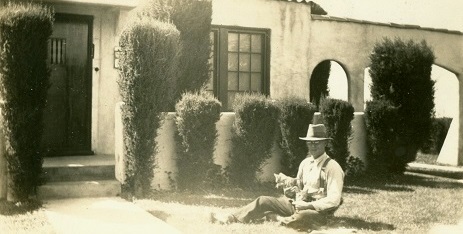
By
1931, the Miners had settled in El Monte, Los Angeles County, CA. They later moved to nearby Rosemead, joining the First
Methodist Church of Alhambra.
The couple later relocated to Pomona, Los Angeles County, where they remained for the rest of their lives. They belonged to the First Methodist Church of Alhambra. During a visit to Washington in August 1938, he told the Reporter that "the Nation is in line for a sweeping political change. Miner said that he talked with garage men, hotel workers, and other average business men on his trip East and found that the majority is dissatisfied with present conditions and in favor of a change in administration. Mr. and Mrs. Miner will leave here next week, returning to California by way of southern and southwestern states."
When an earthquake struck in March 1933, they wrote letters to Will's sister Emma and Osta's sister Eliza Marshall that they were unharmed but "were forced to lean against the wall of their home to keep from falling, but the structure was not damaged," said the Reporter.
Will was fascinated by family history. In September 1928, he helped organize a reunion of the offspring of his grandparents, Henry and Polly (Younkin) Miner. The first one was held at Washington Park, in partnership with his first cousins William R. Bedillion, Golie Cephas Bedillion and Rebecca (Birch) McElfish. That first event was billed erroneously as a gathering of the "William Henry and Elizabeth Yonkon Miner" family, with the Washington Reporter saying:
Members of this family connection are distributed pretty well over the southwest part of the state, and an effort is to be made to form a family organization and make the reunion a regular event. Heretofore family meetings have been held at Confluence, in Somerset county. Mrs. J.A. McElfish, of 46 Seminole avenue, is actively pushing the reunion meeting this year, and she urges every person who is connected in any way with this family group to attend this meeting and help effect a formal organization. Several families, resident in Greene county, are of the Miner descent, and their presence is desired on this occasion.
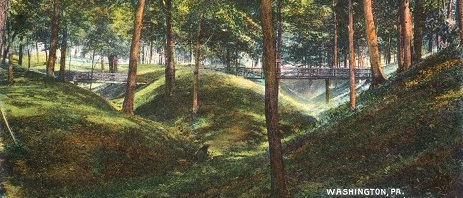 |
| Washington Park, site of the Henry Miner Reunions of 1928-1931 |
That first reunion drew 10 families and a total of 40 people. Reported the Washington Reporter, "After partaking of a bountiful supper, plans were made for an annual reunion. It was decided the reunions would be more successful if held earlier in the year, and the executive committee for the next year is to name the date and place of the 1929 reunion." Will read aloud a history of the family that he had commissioned and was elected president of that first gathering, with cousin W.R. Bedillion as vice president, nephew Odger Miner as secretary and cousin G.C. Bedillion as treasurer. Will's historical report disclosed that the family name had once been spelled "Minerd" with the "d," and that it was of "Pennsylvania Dutch" (German) origin. He promised to send a copy to his niece Jessie (Miner) Schultz, but "he never got around to it," she recalled. Unfortunately, the report was lost, said to have been left behind in the Pomona house where he last lived. Inquiries by his nieces and grand-nieces in the 1970s to locate the report proved fruitless.
The 1929 reunion was held at Wheeling Park in West Virginia. An advance story in the Reporter invited "All persons knowing themselves to be related" and that "Well filled basket should accompany all groups." An article on Aug. 5, 1929 said that the event had "a large attendance" with guests coming from Aliquippa, Charleroi, Washington and Martins Ferry, OH. The slate of elected officers were president W.R. Bedillion of Charleroi, nephew and vice president Orlan Lloyd Miner of Washington, nephew and secretary Odger Miner of Aliquippa and treasurer G.C. Bedillion of Washington.
Then on Aug. 9, 1930, the reunion was billed as "descendants of the Henry Miner and Elizabeth Yonkon Miner" and conducted in Washington Park. The Reporter announced that "All persons related or conected [sic] with this family are invited to attend and take well filled baskets. Election of officers is to take place." After the event was over, the Reporter and the Washington Observer both reported there was "a good attendance. The afternoon was taken up with games and conversation. At 6 o'clock a picnic dinner was served." W.R. Bedillion was re-elected president, nephew Orlan re-elected vice president, cousin Rebecca McElfish as treasurer and cousin Lucy (Bedillion) Martin as treasurer. The Reporter concluded by saying "The miner [sic] reunion will be held in the Washington Park next year, sometime in August."
All that's known of the 1931 reunion -- as the nation slipped deeper into the morass of the Great Depression -- was that it was scheduled to be held on August 8 and the Reporter said that "All members of the family are invited to asked to take a cup, fork and spoon." Another advance story in the Reporter said that "All relatives are invited to join this group taking well filled basket for a sumptious [sic] dinner. Dinner will be served at 6 o'clock."
 |
|
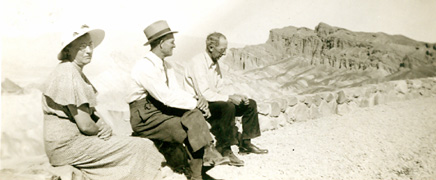
Osta and Will resting with "cousin Burt Gover" at Hoover Dam Lake in 1936 -- a year after the feat of engineering was dedicated by President Roosevelt |
|
At a San Diego mission |
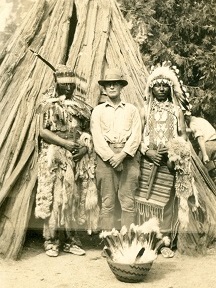
Over the years, Will and Osta vacationed at Yosemite National Park (1931), Pikes Peak (1929), Hoover Dam Lake and an Indian reservation in San Diego. Hoover Dam Lake, completed in 1935, has been called "the greatest dam of its day" and is still a world renowned landmark today.
At
the mission in San Diego circa 1934, Will was photographed with Native
Americans, and stands at center.
Federal census enumeration records show that in 1935-1940, the pair lived in an El Monte residence on Ralph Street.
In
the fall of 1945, Osta became ill, and they decided to return to Washington for
treatment. Her debilities included diabetes, hypertension and hardening of the arteries. Their address at that time was 395 Burton Avenue. Sadly,
on
Oct. 15, 1945, Osta died in the Hillsview Clinic after a stay of 40 days. Her official Pennsylvania death certificate was signed by her sister Eliza Marshall. The funeral service was jointly conducted by Rev. John W. Love, of the First Christian Church, and Rev. John H. Debolt of the West Washington Methodist Church.
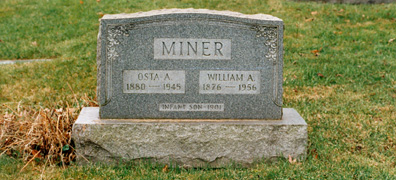
Her remains were lowered into eternal sleep in the Miner
family plot at the Washington Cemetery. Will also arranged for their infant son's
remains to be relocated to rest at her side. While ordering her grave marker,
Will also purchased a small stone to mark the graves of his grandparents, Henry and
Polly (Younkin) Minerd, who had been dead for some 60 years, and whose ashes lay
buried on a small private farm
cemetery near New Freeport, Greene County, PA.
For some time after Osta's death, Will suffered from a bout with severe depression, and may have suffered an emotional breakdown. During part of that time, he resided with nephew Odger Miner near Aliquippa, Beaver County, PA. He underwent electro-shock therapy at St. Francis Hospital in Pittsburgh and fortunately recovered. Will was so grateful for the loving care provided by the nephew and his family that he went to their local bank and paid off the balance of their mortgage.
In
1947, with his health restored, Will returned to Southern California. On Oct. 2, 1947, at the age of 73, he was joined in wedlock with 51-year-old Laura
Thompson (1896-1982). It was considered by family as a "marriage of convenience." They were together for nine years until the separation of death.
Breaking from their Methodist roots, he joined the Baptist Church of Pomona, and
was a member of the Sunday School.
In the 1950s, Will and Laura received occasional visits from his nephew Orlan Lloyd Miner, who resided in Monrovia, CA, and from grand-nephew Odger "Wayne" Miner, stationed at the Presidio of Monterey during the Korean War.
 |
|
Graves of Will, Osta and their infant son at Washington (PA) Cemetery |
|
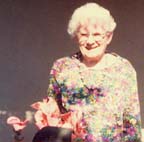
Laura Miner, 1978 |
Will and Laura's final address was 69 East Alvarado Street. There, he died at age 80 on Oct. 2, 1956 at Pomona. An obituary in the Pomona Progress said he "came to California in 1906 from Washington, Pa., and lived in several Southern California communities, including several years in Rosemead. He has resided in Pomona for the last nine years..." Following funeral services led by Rev. Edward B. Cole of the family church, the remains were shipped back to Washington for burial. He rests with Osta and their infant son at Washington Cemetery.
Laura outlived Will by many years. In July 1978, while residing in a nursing home in LaVerne, Los Angeles County, CA, she received a return visit from her husband's grand-nephew, Wayne Miner, and his family from the Pittsburgh area. They visited for a few hours, and she graciously brought out an old photograph album of snapshots to show to her guests. She admitted that she did not know much about Will's family back east, she said, but she did recall Wayne's visits during the Korean War era.
She was photographed that day in front of her residence, in the Southern California sunlight. She passed away fouryears later, at age 86, in January 1982.
Will is mentioned in Rev. Fred Cochran's history, The Swarts United Methodist Church -- 171st Anniversary.
Copyright © 2000, 2002, 2005-2006, 2008, 2010-2011, 2020, 2023 Mark A. Miner